AI Systems · Agentic AI · AI automation · RPA · Guide
Agentic AI vs traditional automation: what is the difference?
 Eimantas KazėnasFounder, RevflowsUpdated Published
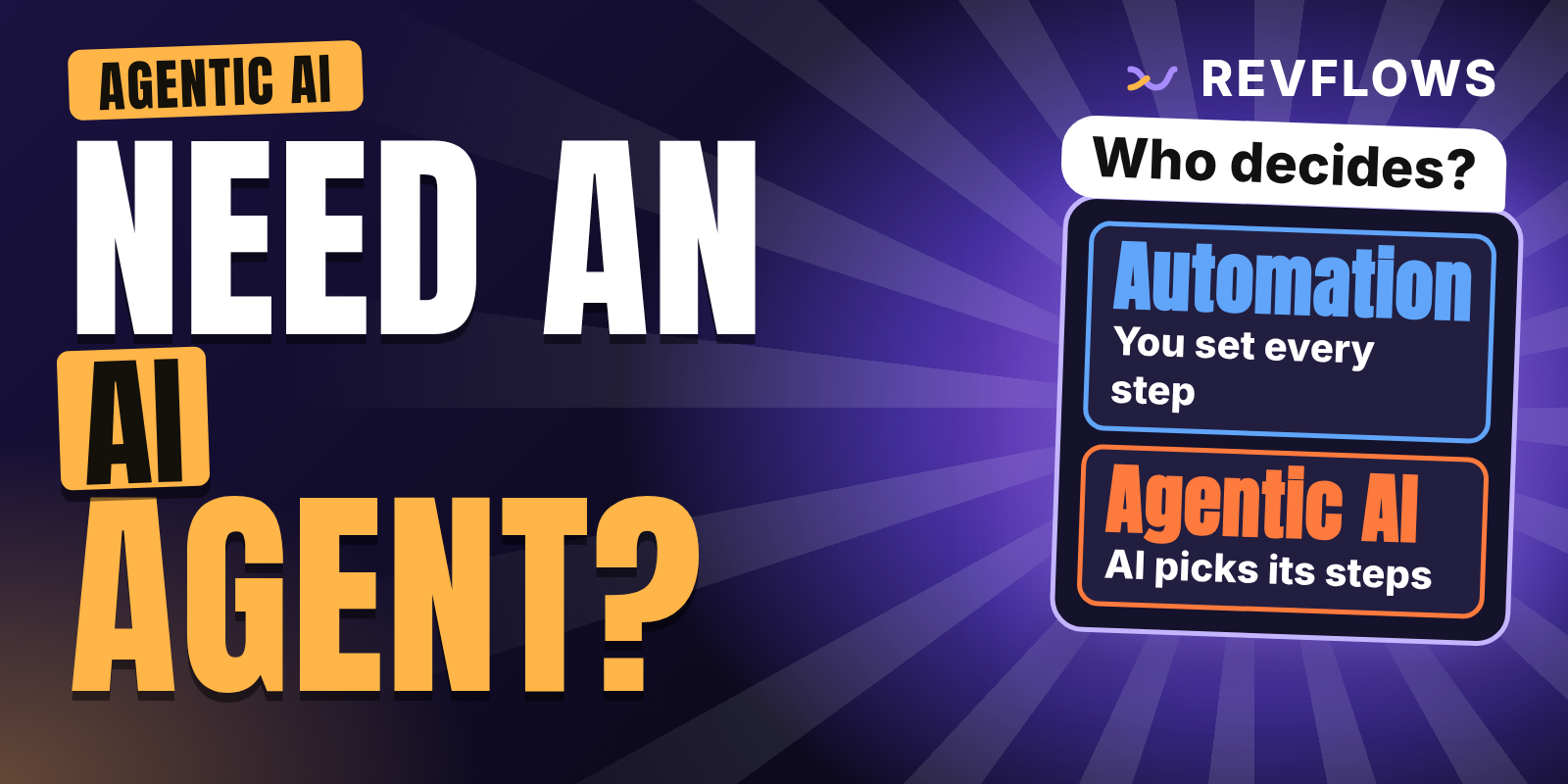
Traditional automation, including RPA, follows steps a person wrote in advance. The same input gives the same result, and it is cheap and easy to check. Agentic AI is given a goal and tools and decides its own steps, which makes it better at messy, open jobs and harder to predict. Most small business jobs are best served by fixed-step automation, with an AI step added where judgement is needed. Use an agent only when the job needs it, and keep approvals on.
Key takeaways
- The difference is who decides the steps. In traditional automation, you do. In agentic AI, the AI does.
- Automation is predictable, cheap and easy to check. Agents handle messy, open jobs but can surprise you.
- Most small business jobs need fixed steps, with an AI step added where judgement is needed.
- Gartner expects over 40% of agentic AI projects to be canceled by the end of 2027.
- Pick the simplest tool that does the job. Keep approvals on for anything risky.
“Agentic AI” is everywhere. So is the sales pitch that it replaces your automations.
It doesn’t, and most of the time it shouldn’t. The two do different jobs.
This guide explains the difference in plain words. It is part of our guide to what is AI automation, where we cover the three levels from rule-based flows to agents.
The short answer
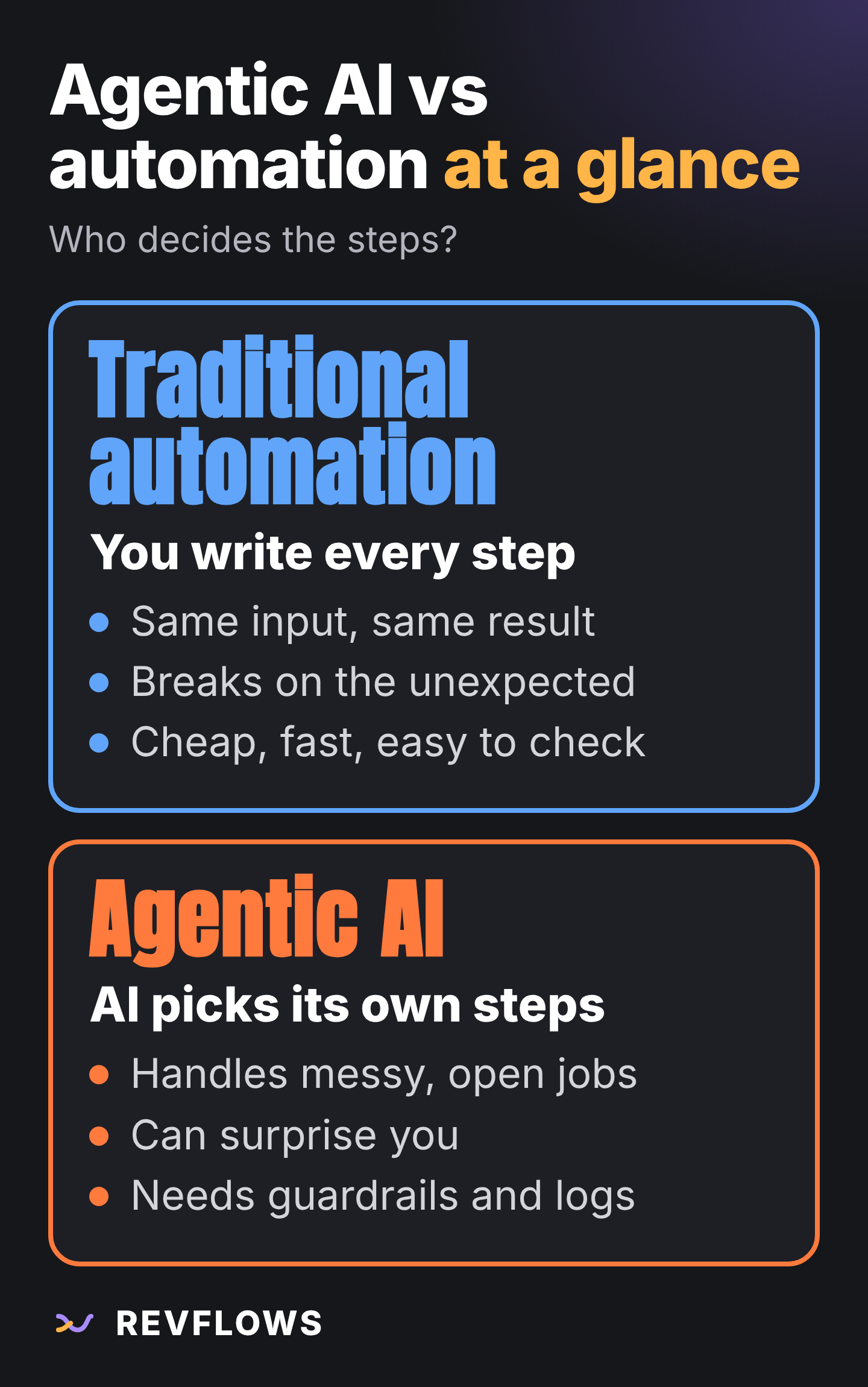
Traditional automation follows the steps you give it. Agentic AI chooses its own steps to reach a goal.
Think of a new employee. With automation, you hand them a checklist and they follow it every time. With an agent, you say “get these inquiries answered and booked” and they work out how.
What is traditional automation?
Traditional automation is software that repeats fixed steps. If this happens, do that. It includes:
- Workflow tools like Zapier, Make and n8n. A form is submitted, so a row is added to a sheet and an email goes out. We compare them in n8n vs Zapier vs Make.
- RPA (robotic process automation). IBM describes it as software that performs repetitive office tasks of human workers, such as extracting data, filling in forms and moving files, using rule-based logic.
The key point from IBM: RPA is process-driven. RPA bots can follow only the processes a person defines. That is a strength, not a flaw. Same input, same result, every time.
What is agentic AI?
Agentic AI is a system that can accomplish a goal with limited supervision. IBM describes it as AI agents that mimic human decision-making to solve problems in real time. An agent can search, call other software, read the result and decide what to do next.
Anthropic, an AI company, draws a clean line between two kinds of system:
“Workflows are systems where LLMs and tools are orchestrated through predefined code paths. Agents, on the other hand, are systems where LLMs dynamically direct their own processes and tool usage, maintaining control over how they accomplish tasks.”
In plain words: if you wrote the path, it’s a workflow. If the AI picks the path, it’s an agent. We explain agents and the jobs they suit in AI agents for small business.
Agentic AI vs traditional automation: the differences
| Traditional automation | Agentic AI | |
|---|---|---|
| Who decides the steps | You, in advance | The AI, as it goes |
| Best at | Routine, predictable tasks | Messy, open-ended jobs |
| Input | Tidy and structured | Free text, mixed sources |
| Same input, same result? | Yes | Not always |
| When something unexpected happens | Stops or errors | Tries another way |
| Checking it | Easy: follow the steps | Harder: read the logs |
| Main risk | Breaks when things change | Takes a wrong action on its own |
| Setup | Rules and connections | Goal, rules, tools and guardrails |
Neither column is “better”. They suit different jobs.
RPA vs AI: a quick note
People mix up RPA and AI. IBM says the two are distinctly different. RPA is process-driven, while AI is data-driven: it recognizes patterns in data, including unstructured data. RPA replicates human-directed tasks. They also work together, because AI can help RPA handle more complex cases.
That is why AI added to a fixed flow is so useful. It is the middle level in our AI automation guide: steps you design, with AI reading, sorting or writing inside them.
Same job, two ways
Take overdue invoices.
With traditional automation: every Monday, find invoices unpaid after 14 days and send reminder 1. After 30 days, send reminder 2. Simple and reliable.
With an agent: “Get overdue invoices paid.” It looks up each client, reads their past replies, decides whether to chase, call or flag it, writes a message in the right tone and updates the CRM.
The first is cheaper and easier to trust. The second is better when clients reply in varied ways and each case needs a decision.
Now take new inquiries. A fixed flow can sort them by a form dropdown. When people write free text in different ways, an AI step can read and sort them. An agent can go further: check your calendar, answer the question and book the call.
What Gartner says
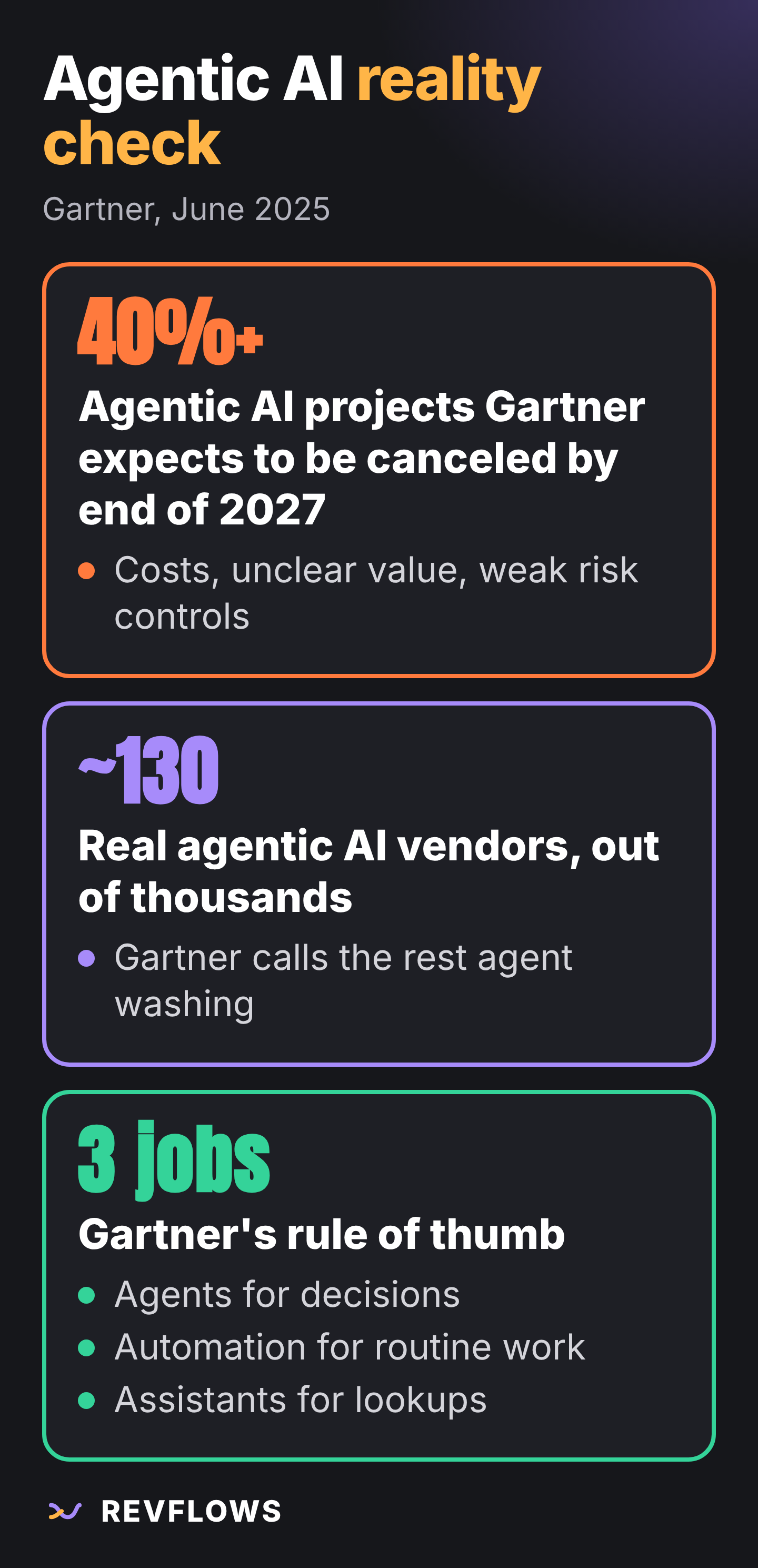
Gartner is a research firm that advises big companies on technology. Its June 2025 forecast has three points worth knowing:
- Over 40% of agentic AI projects will be canceled by the end of 2027. The reasons: rising costs, unclear business value or inadequate risk controls.
- “Agent washing” is common. Vendors rebrand existing products, such as assistants, RPA and chatbots, without real agentic features. Gartner estimates only about 130 of the thousands of agentic AI vendors are real.
- Match the tool to the job. Gartner says to use AI agents when decisions are needed, automation for routine workflows and assistants for simple retrieval.
Anthropic gives the same advice from the builder’s side. It recommends finding the simplest solution possible and only adding complexity when needed, which might mean not building agentic systems at all.
How to choose: 3 questions
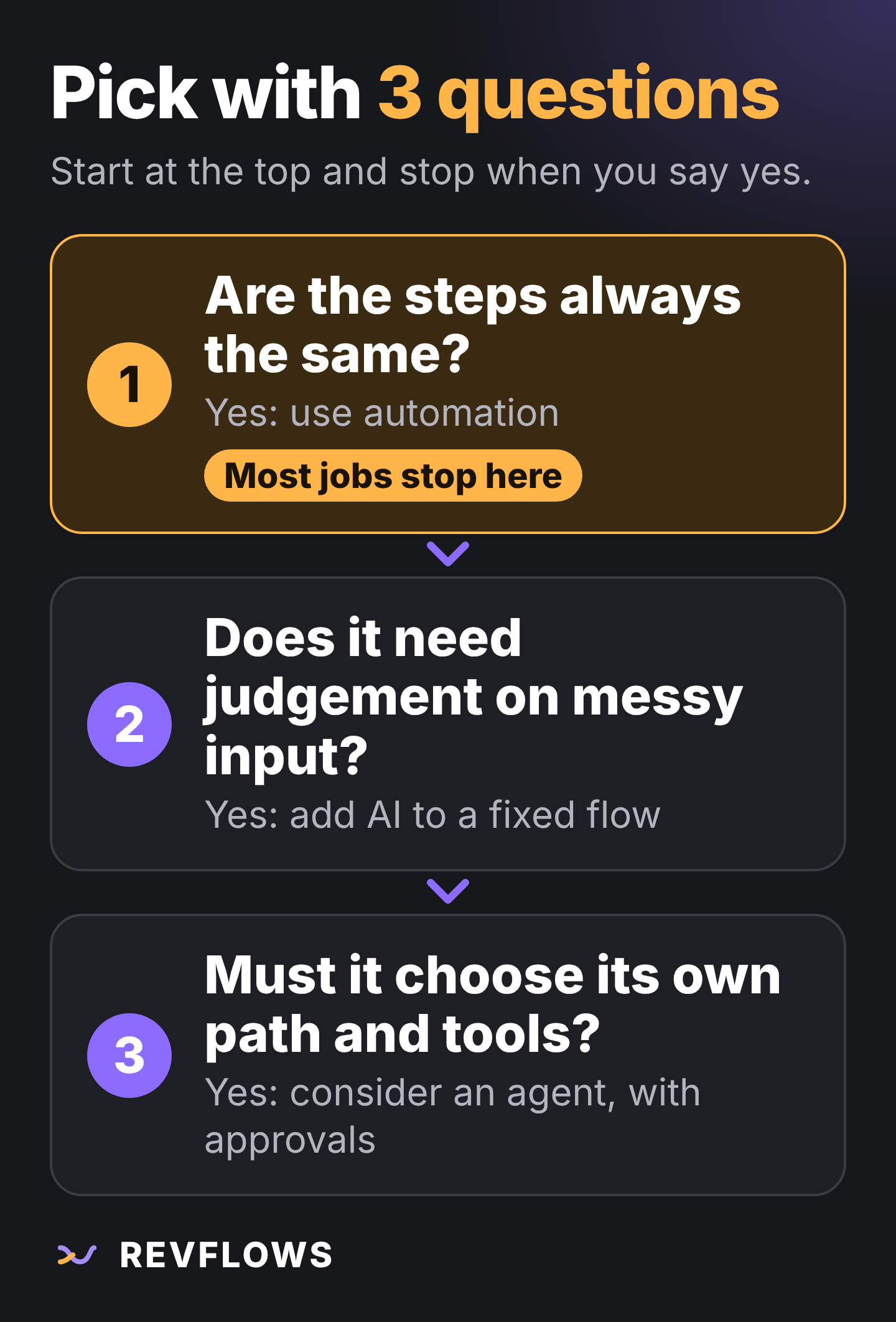
Ask in this order, and stop at the first yes.
- Are the steps always the same? Then use traditional automation. Most small business jobs stop here.
- Are the steps fixed, but the input is messy? Emails, PDFs, calls or free text? Keep the fixed flow and add an AI step inside it.
- Does it need to choose its own path and tools? Then consider an agent. Start with approvals on.
A good test is also whether you can check the result easily. If a wrong answer is cheap and obvious, an agent is low risk. If a wrong answer costs money or trust, keep a person in the loop.
What this means for your business
- A clinic or spa: automate reminders, confirmations and follow-ups with fixed flows. Consider an agent for answering varied patient questions and booking, with a human approving anything about prices or treatment.
- A hotel or restaurant: automate booking confirmations and review requests. An agent can handle varied guest requests, with a rule for when to hand over to staff.
- An online shop: automate order emails and stock alerts. An agent may help with support chats, but keep refunds behind approval.
- A software or service firm: automate lead routing and onboarding. An agent can research and qualify leads.
Whatever you pick, connect your tools first. Agents need clean access to your data. We cover this in what is an MCP server, and the first-project plan is in AI automation for small business.
Guardrails for agents
If you do use an agent, set these first:
- one job, one clear goal,
- least access: only the tools it needs,
- human approval for money, refunds, deletions and anything sent to customers at first,
- logs of what it read, decided and did,
- a weekly review for the first month.
The full list is in our AI agents guide.
Our view
- Start with fixed steps. They are cheaper, faster and easier to trust.
- Add AI inside the flow. It covers most “messy input” jobs without giving up control.
- Use an agent only when the job needs choices. And earn its autonomy with evidence, not hope.
Build the right level of automation
Not sure whether you need a flow, an AI step or an agent? We map your repeat tasks, build the simplest automation that works, and add AI agents only where they pay, with approvals, logs and weekly reports built in.
Questions
What is the difference between agentic AI and traditional automation?
Who decides the steps. In traditional automation a person writes every step in advance, and the software repeats it exactly. In agentic AI you give the system a goal and tools, and it decides its own steps and which tools to use. Anthropic puts it as predefined code paths versus models that dynamically direct their own process.
What is the difference between RPA and agentic AI?
RPA (robotic process automation) is rule-based software that copies repetitive tasks people do, such as moving data and filling in forms. IBM says RPA can follow only the processes a person defines, while AI recognizes patterns in data. Agentic AI goes further by choosing what to do next toward a goal.
Is agentic AI better than traditional automation?
Not by default. Agentic AI is better for messy, open-ended jobs. Traditional automation is better for routine, predictable ones because it is cheaper, faster and easier to check. Gartner's advice is to use agents when decisions are needed, automation for routine workflows and assistants for simple retrieval.
Are tools like Zapier, Make and n8n agentic AI?
On their own they are workflow automation: you set the steps. Adding an AI step inside a fixed flow, such as sorting an email, still follows Anthropic's definition of a workflow. It becomes an agent when the AI chooses its own steps and tools.
Do small businesses need agentic AI?
Usually not at first. Most small business hours are saved by fixed-step automation, with AI added to read or write inside it. Consider an agent for open-ended jobs, such as answering and sorting varied inquiries, and start with approvals on.
What are the risks of agentic AI?
It is harder to predict, can take wrong actions on its own, and costs more to run and check. Gartner expects over 40% of agentic AI projects to be canceled by the end of 2027 because of rising costs, unclear business value or inadequate risk controls.