AI-Era Visibility · AEO · SEO · GEO · AI search
AEO vs SEO vs GEO: what is different and what to do first
 Eimantas KazėnasFounder, RevflowsUpdated Published
SEO gets your page ranked in a list of links. AEO gets your business named inside an AI answer. GEO is the research name for AEO, so treat them as the same job. All three rest on the same base: a site search engines can read and trust. Fix SEO basics first, then make your facts specific and consistent.
Key takeaways
- SEO gets your page ranked. AEO gets your business named inside an AI answer.
- GEO and AEO are the same work under two names. Don't pay twice for one job.
- AI answers pull from search indexes, so broken SEO blocks AEO.
- Do the work in this order: SEO basics, fact sheet, answer pages, monthly testing.
- Smaller sites can win AI answers with clearer, more specific pages, even without ranking first.
Three acronyms, one question from every owner: which one do I need?
Short answer: SEO gets your page ranked in a list of links. AEO gets your business named inside an AI answer. GEO is the research name for AEO. They share one base. Do SEO basics first, then the AEO work on top.
If you are new to the term, start with our plain guide: what is AEO.
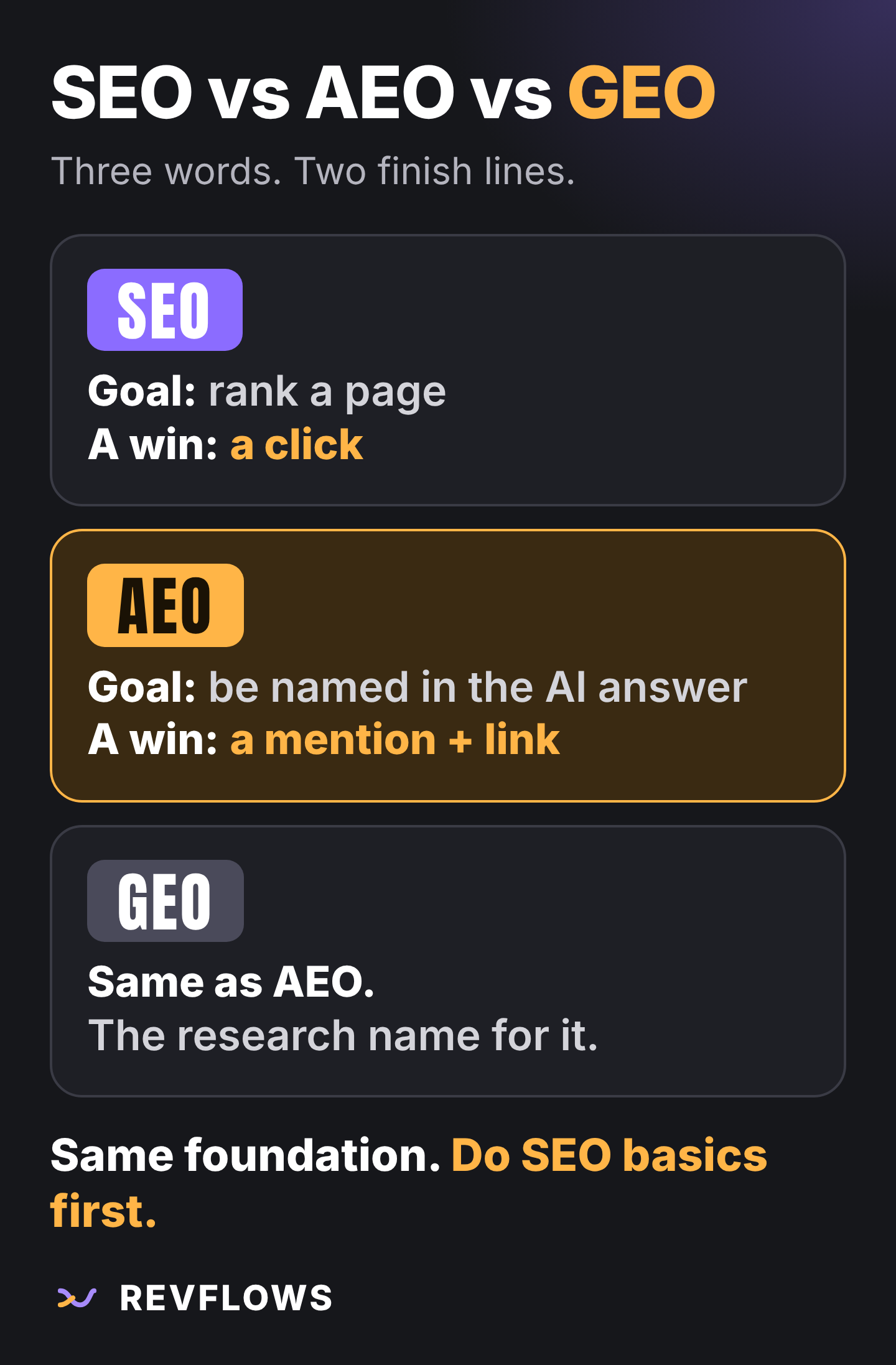
AEO vs SEO vs GEO: what does each one mean?
| SEO | AEO | GEO | |
|---|---|---|---|
| Stands for | Search engine optimization | Answer engine optimization | Generative engine optimization |
| Goal | Rank a page in search results | Get named or linked in an AI answer | Same as AEO |
| Where | Google and Bing results | ChatGPT, Perplexity, Gemini, Copilot, AI Overviews, AI Mode | Same as AEO |
| A win looks like | A click from the results page | Your business named, with a link | Same as AEO |
| Who uses the word | Everyone | Marketers and agencies | Researchers, Microsoft, some agencies |
What is SEO?
SEO is the work of getting your pages found in search results. A page must be crawlable (a search program can read it), indexed (stored in the search database) and relevant to what people type.
You win when someone sees your link and clicks it.
What is AEO?
AEO is the work of getting AI tools to name your business when they answer a customer’s question. An answer engine replies with written text, not a list of links.
You win when the answer says your name and links your page.
What is GEO?
GEO comes from a 2023 research paper by a team from Princeton and IIT Delhi, presented at the KDD 2024 conference. They called AI answer tools “generative engines” and studied how pages get picked as sources. You can read the GEO paper on arXiv.
Microsoft now uses the term too. When it launched a report showing how often Copilot cites your site, it called it:
“an early step toward Generative Engine Optimization (GEO) tooling in Bing Webmaster Tools”
Is there a difference between AEO and GEO?
No real difference for a business owner. AEO is the marketing name. GEO is the research name. AI SEO and LLM SEO describe the same work.
Google’s Danny Sullivan made the same point in a keynote at WordCamp US, as reported by Search Engine Land:
“Good SEO is good GEO, or AEO, AIO, LLM SEO, or LMNOPO. So, they’re all fine.”
Our view: pick one word and move on. If two providers sell you “AEO” and “GEO” as separate services, you are paying twice for one job.
What actually changes when AI answers the question?
The base stays. Four things change.
1. The finish line moves from a click to a mention
People click less when an AI summary sits on top. Pew Research Center tracked real browsing from 900 US adults in March 2025. Users clicked a normal result on 8% of visits when an AI summary appeared, and on 15% when it did not, according to Pew’s analysis. Links inside the summary got clicked on just 1% of visits.
Ahrefs found the same direction in its own data. For the top-ranking page, an AI Overview now goes with a 58% lower click-through rate, per its December 2025 re-run.
So being ranked is no longer enough. You want to be the name inside the answer.
2. Questions get longer
People type short keywords into Google. They ask AI tools full questions with a city, a budget and a need.
Google says queries in AI Mode are on average three times longer than traditional searches, per Sundar Pichai’s Q3 2026 earnings remarks. AI Mode alone passed 1 billion monthly users, according to his Q2 2026 remarks.
A page built for “dentist Bangkok” is too thin. You need a page that answers “how much are implants in Bangkok for a patient flying in from Sydney”.
3. Your facts must match everywhere
A search engine ranks one page. An answer engine compares sources before it names you. If your website, Google Business Profile and directory listings disagree on prices, hours or services, the engine is less sure, and names someone else.
4. You measure different things
Rankings and clicks still count. Add two more: how often AI tools name you for your key questions, and how many enquiries come from AI. Our guide to measuring AI search visibility shows how.
What stays the same?
Almost everything technical. Google’s guide on AI features says:
“The best practices for SEO remain relevant for AI features in Google Search (such as AI Overviews and AI Mode).”
In plain terms:
- Pages must load and be crawlable. If a crawler can’t read a page, no engine can use it.
- Pages must be indexed. Google only uses pages it has stored and may show with a snippet.
- Content must be useful to a person. Clear, specific and original still wins.
- Links between your pages still matter. They help crawlers find and connect your content.
Can a smaller business beat bigger sites in AI answers?
Sometimes, yes. This is the most useful finding in the GEO research.
In lab tests, the authors found that clearer, better-sourced content helped lower-ranked pages far more than top-ranked ones. Their summary of the result:
“GEO is especially helpful for lower ranked websites.”
In one test, adding citations to credible sources more than doubled the visibility of the page that sat fifth in search results (up 115%), while the top-ranked page lost ground. That was a benchmark, not a promise.
What this means for you: you may never outrank a national directory for “best clinic in Bangkok”. You can still be the clinic with the clearest price page, the named dentist and the reviews that match. That gives an answer engine a reason to quote you.
What should you do first?
Work in this order. Each step makes the next one count.
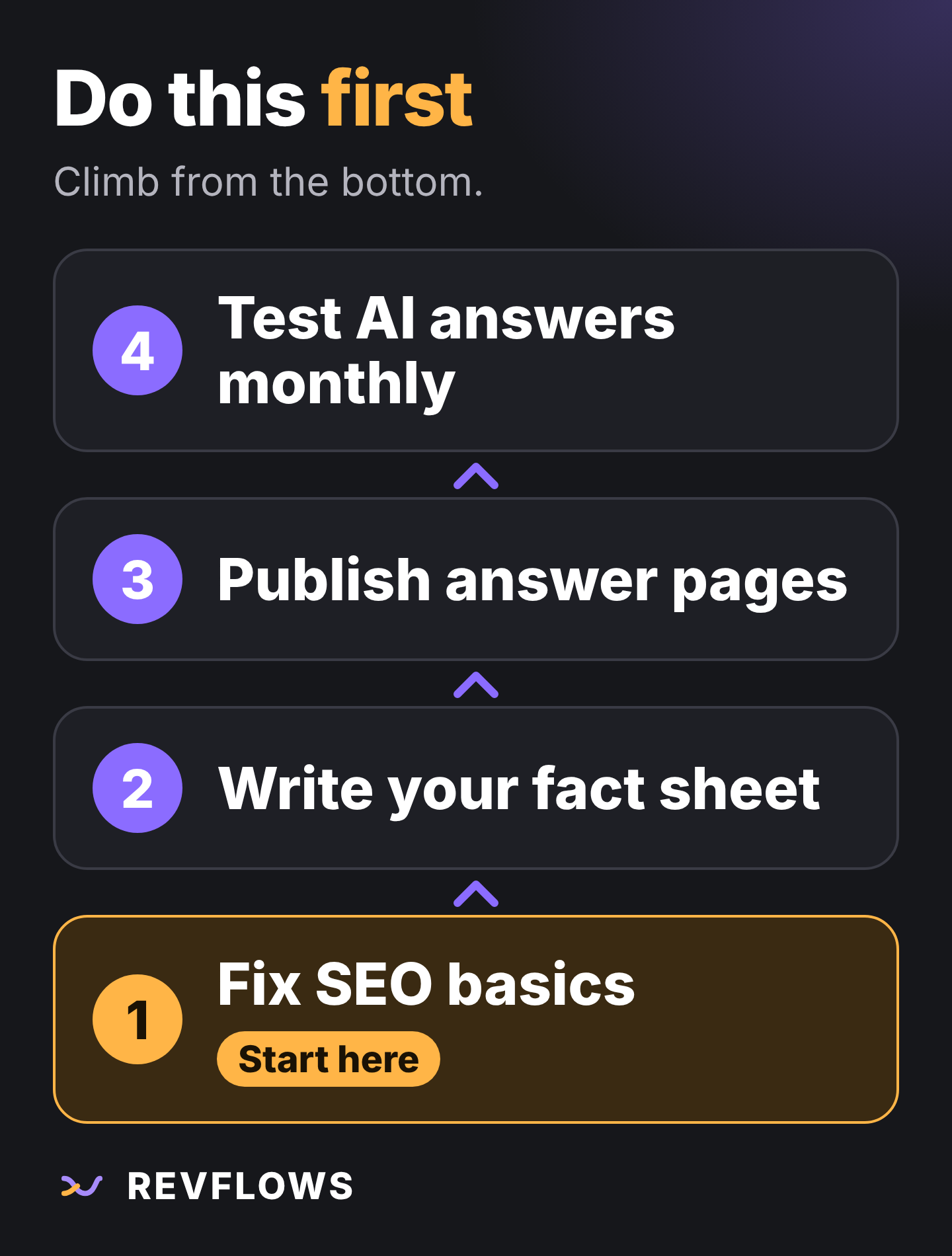
- Fix the SEO basics. Check that your key pages load fast, are indexed in Google Search Console, and are not blocked in robots.txt (the file that tells crawlers what they may read).
- Write your fact sheet. One page with your services, city, price ranges, named people, hours and booking method. Make every listing match it.
- Publish answer pages. One page per real customer question. Put the answer in the first two sentences.
- Test AI answers monthly. Ask the same 10 to 20 questions in ChatGPT, Perplexity, Gemini and Google. Turn every miss into a new page.
The five AEO steps in our pillar guide go deeper on each one. For the website side, use our AI search optimization checklist.
Where to start, by situation
| If this is you | Start here |
|---|---|
| Your site is new or barely shows in Google | SEO basics: indexing, speed, one page per service |
| You rank in Google, but AI tools never name you | Fact sheet, listings and answer pages |
| AI tools name you with wrong prices or hours | Fix your listings and your fact page first |
| You don’t know where you stand | Run 10 customer questions in ChatGPT and Google today |
Our view: stop arguing about the name
- Buy outcomes, not acronyms. Ask any provider which questions they will track and how they will tie results to enquiries.
- Don’t split one budget into three. SEO, AEO and GEO share most of the work. A good page serves all three.
- Specific beats clever. A page that states a treatment, a city and a price gives an AI tool something to quote. A slogan does not.
Check where you stand
Free AI visibility check. Answer a few questions about your business and see where AI assistants are likely to skip you, and what to fix first.
Questions
What is the difference between AEO and SEO?
SEO aims to rank your page in a list of search results so people click it. AEO aims to get your business named, or your page linked, inside an answer written by ChatGPT, Perplexity, Gemini or Google's AI Overviews. AEO builds on SEO, because answer engines pull their sources from search indexes.
Is GEO the same as AEO?
For a business owner, yes. GEO (generative engine optimization) is the name used in the 2023 research paper that first studied the idea. AEO (answer engine optimization) is the name most marketers use. AI SEO and LLM SEO mean the same work.
Is AEO replacing SEO?
No. Google says its SEO best practices still apply to AI Overviews and AI Mode, and ChatGPT and Perplexity also find pages through search crawlers. What changes is the finish line: being named in the answer matters more, because people click fewer links when an AI summary appears.
Should a small business do SEO or AEO first?
Fix the SEO basics first: pages that load, can be crawled and are indexed. Then do the AEO work: one fact sheet, the same facts on every listing, and one page per real customer question. Most of the AEO work also improves normal SEO.
Do I need a separate agency for AEO and SEO?
Usually not. The work overlaps heavily. Ask any provider how they will test whether AI tools name you, which questions they will track, and how they will tie it to enquiries. If they cannot answer, the label on the service does not matter.