AI-Era Visibility · AI visibility · Measurement · AEO · AI search
How to measure AI search visibility (and what a good score looks like)
 Eimantas KazėnasFounder, RevflowsUpdated Published
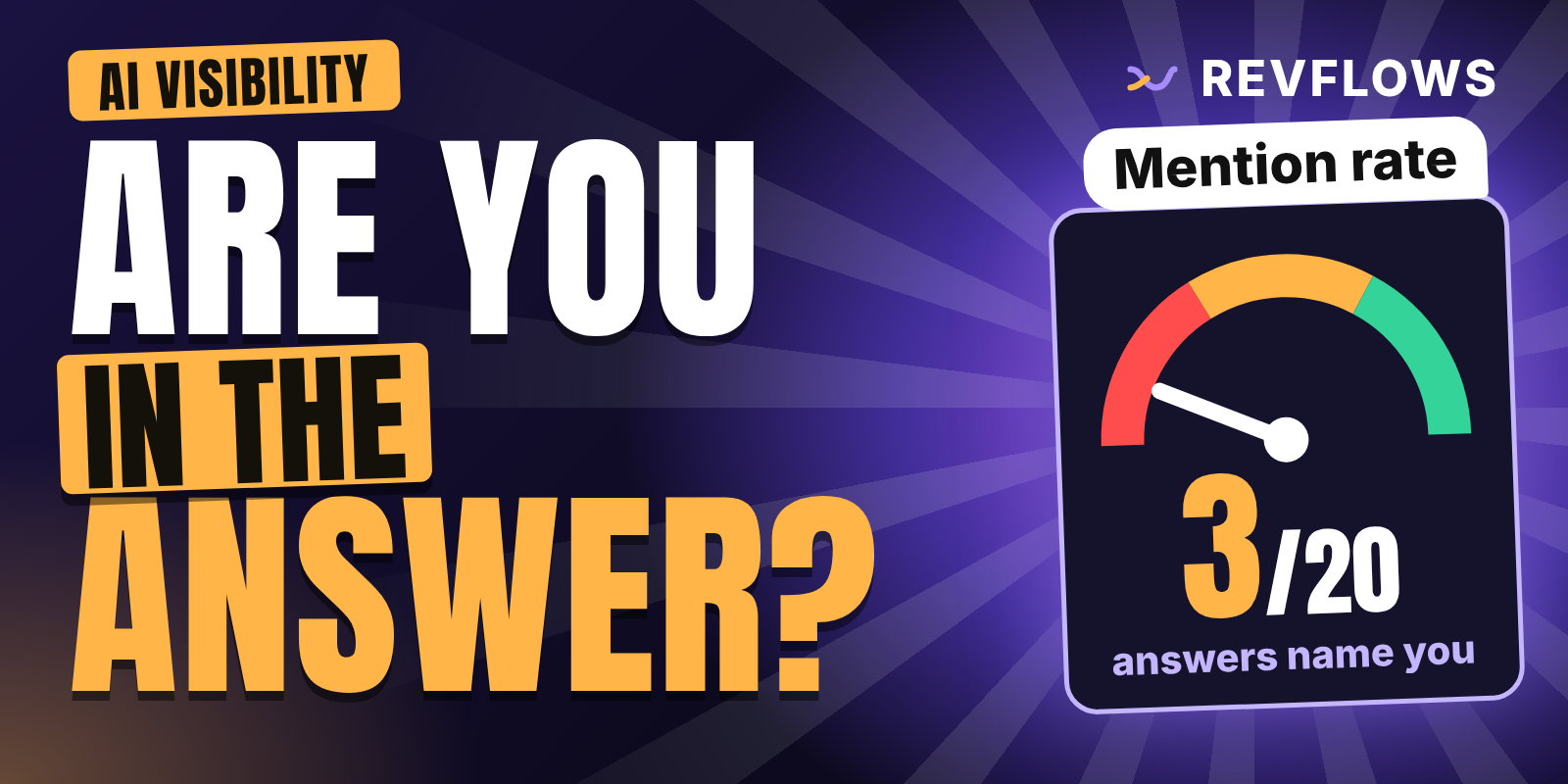
Measure AI search visibility by asking a fixed set of 20 real customer questions in ChatGPT, Perplexity, Gemini and Google every month, several times each. Track four numbers: how often you are named, how often your pages are linked, your share against competitors, and leads from AI. Add the free AI reports in Google Search Console, Bing Webmaster Tools and GA4.
Key takeaways
- AI answers change every time you ask. Track percentages over many runs, not one screenshot.
- Use a fixed set of 20 real customer questions, asked several times in each tool, every month.
- Track four numbers: mention rate, citation rate, share of answer and leads from AI.
- Add the free reports: Google Search Console's AI report, Bing's AI Performance and GA4's AI Assistant channel.
- A good score is one that rises and beats your top competitor. There is no industry benchmark yet.
You can’t open a rank tracker and see your position in ChatGPT. There is no position. Each answer is written fresh, for each person.
To measure AI search visibility, ask a fixed set of real customer questions in each AI tool, several times each, every month, and count how often you are named. Then add the free AI reports from Google, Bing and Google Analytics.
This is step 5 of the five AEO steps: test, then turn every gap into work.
What is AI search visibility?
AI search visibility is how often AI tools name your business or link your pages when people ask questions in your market. It’s usually shown as a percentage: “named in 6 of 20 answers” is 30%.
It is not traffic. You can be named often and get few clicks. That’s why you also track leads.
Why one screenshot proves nothing
AI answers are not stable. SparkToro asked 600 volunteers to run the same 12 prompts through ChatGPT, Claude and Google’s AI a combined 2,961 times. Rand Fishkin’s summary:
“there’s a <1 in 100 chance that ChatGPT or Google’s AI, if asked 100X, will give you the same list of brands in any two responses.”
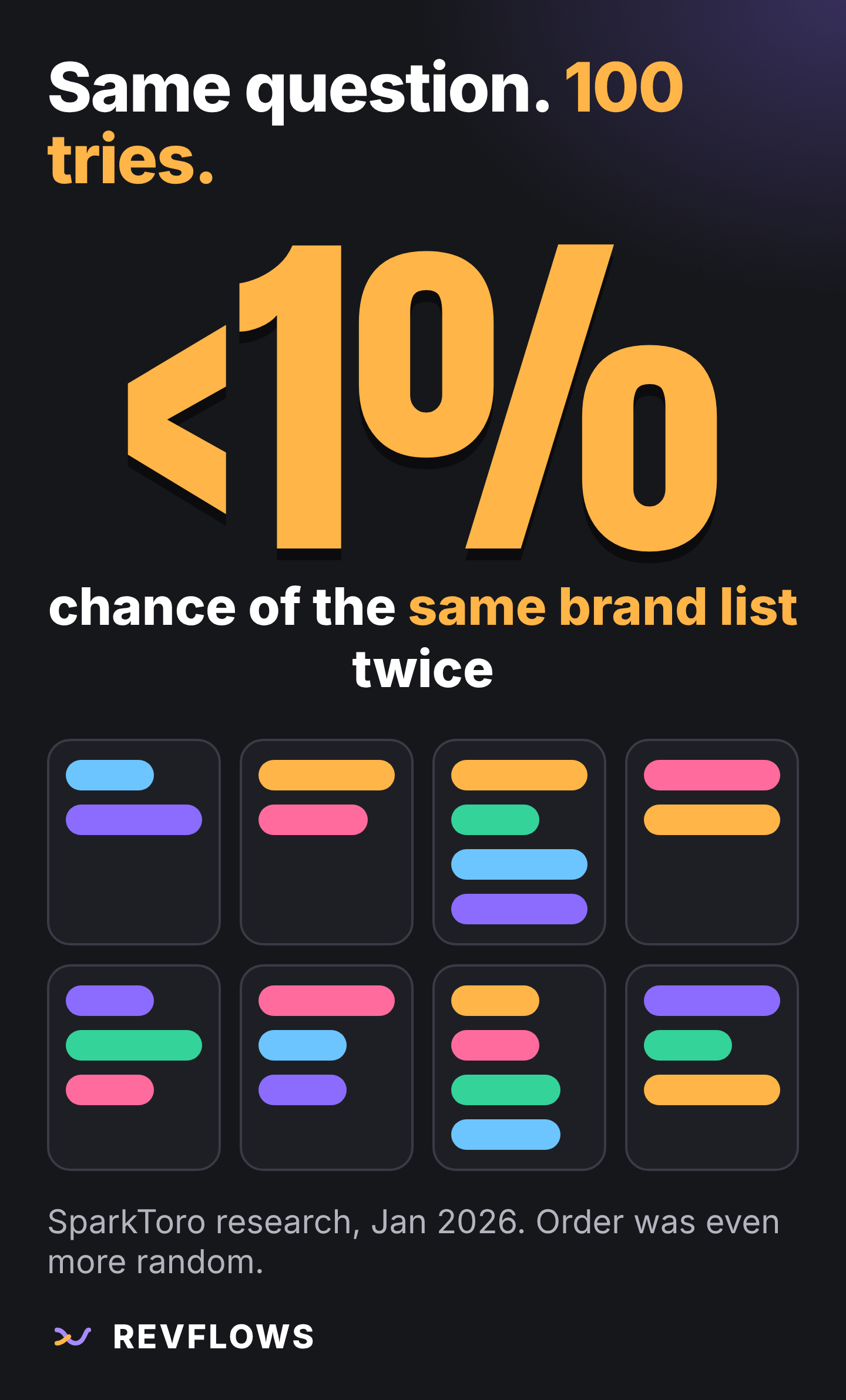
The order was even more random. So “we’re number 2 in ChatGPT” means very little.
What did hold up? How often a brand appears across many answers. Fishkin, who started as a sceptic, changed his mind:
“I’ve been swayed from my initial position and now believe visibility % across dozens to hundreds of prompts run multiple times is a reasonable metric.”
That is the method below: many questions, several runs, count the percentage.
The four numbers to track
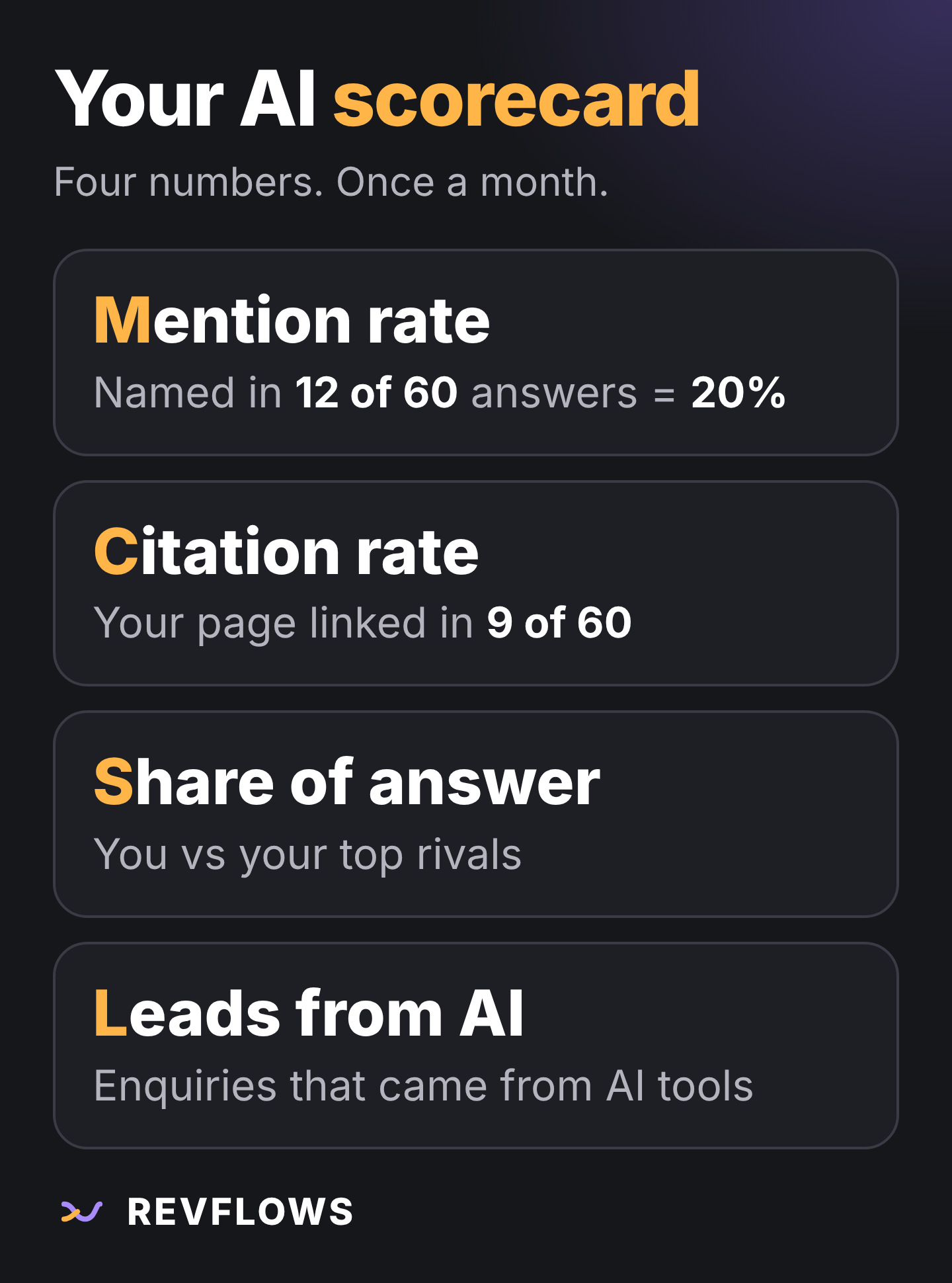
| Number | What it means | How to work it out |
|---|---|---|
| Mention rate | How often you are named | Answers that name you ÷ all answers |
| Citation rate | How often your pages are linked as a source | Answers that link your site ÷ all answers |
| Share of answer | Your mentions against competitors | Your mentions ÷ mentions of you plus your top 3 competitors |
| Leads from AI | Enquiries that came from AI tools | Analytics plus “How did you hear about us?” |
Example: you ask 20 questions, 3 times each, in ChatGPT. That’s 60 answers. You are named in 12. Your mention rate in ChatGPT is 20%. Your top competitor is named in 30, so they’re at 50%. You know the gap, and you know which questions to work on.
How to measure it: step by step
1. Write 20 customer questions
Use questions real customers ask, with your service and city. Mix four types:
- Best-of: “Best dental clinic in Ho Chi Minh City for implants”
- Price: “How much is a family room in Ubud with breakfast?”
- Comparison: “Is it cheaper to get veneers in Bangkok or Sydney?”
- Problem: “My tooth implant feels loose, where can I get it checked in District 1?”
Find them in sales calls, chats, enquiry forms and Google’s “People also ask” boxes. Keep the list fixed so months compare fairly.
2. Ask each one several times, in each tool
Ask every question at least three times in ChatGPT, Perplexity, Gemini and Google (AI Overviews or AI Mode). Use a fresh chat each time. Note the date and the country you asked from, because answers change by location.
3. Record names and links
Use one spreadsheet row per answer: tool, question, run, businesses named, whether you were named, and which of your pages were linked.
4. Work out your four numbers
Do it per tool and overall. Different tools can rate you very differently.
5. Turn gaps into work
Every question where you’re missing points to a fix:
- Not named, no page of yours answers it: write the page. See our AI search optimization checklist.
- Named with wrong facts: fix your listings and fact page.
- Competitors named, with review sites linked: work on reviews and listings. See how to get recommended by ChatGPT.
Free data from Google, Bing and Google Analytics
Manual tests show what AI says. These reports show what happened on your site. All are free.
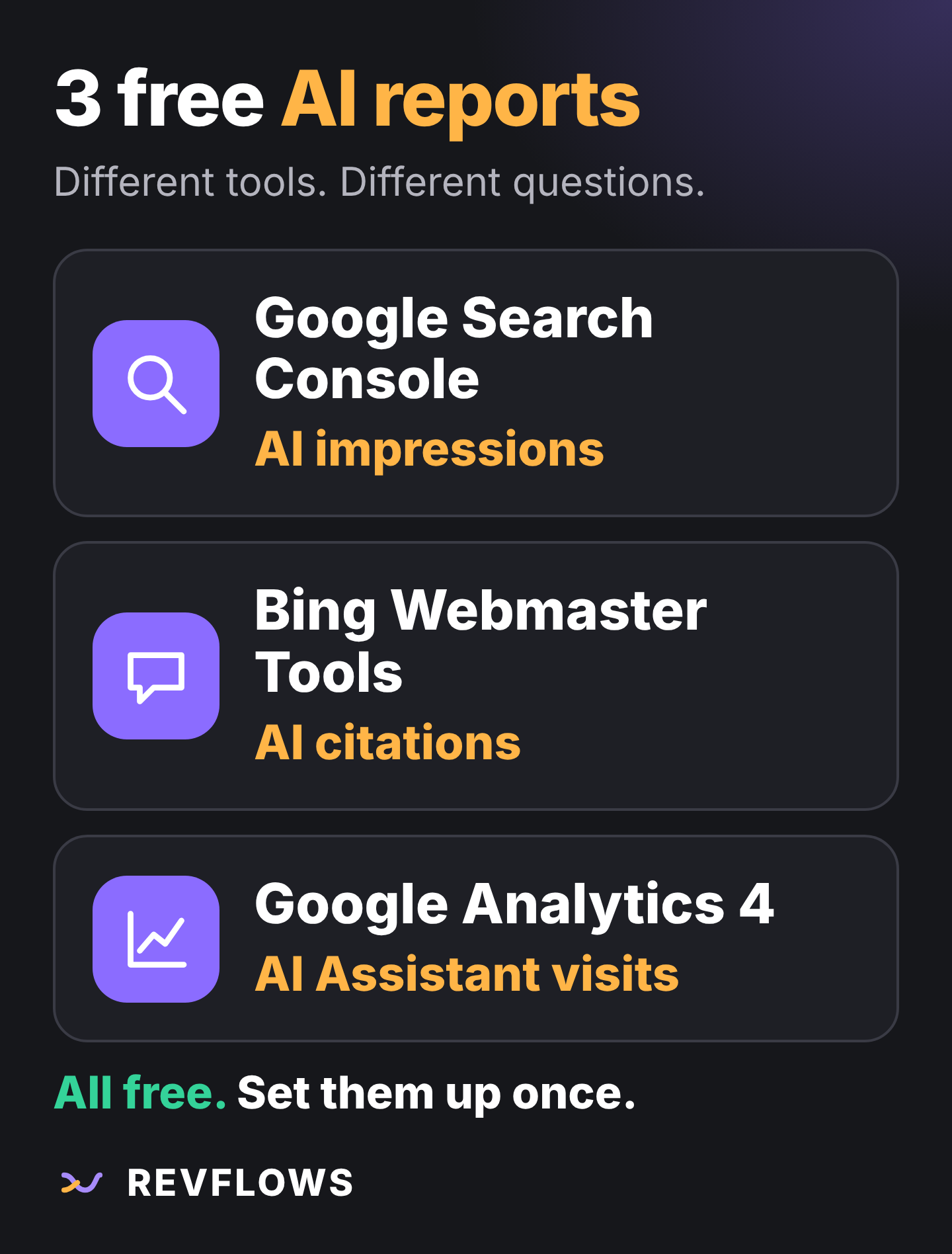
Google Search Console: AI impressions
Google launched generative AI performance reports in June 2026 and rolled them out to all websites on 31 August 2026. They show impressions, pages, countries, devices and dates for your appearances in AI Overviews and AI Mode.
Clicks from those features count inside the normal “Web” performance report, per Google’s AI features guide.
Bing Webmaster Tools: AI citations
Bing’s AI Performance report shows how often your pages are cited in Microsoft Copilot, Bing’s AI summaries and some partner tools. It lists your most cited pages and a sample of “grounding queries” (the key phrases the AI used to find content), per Microsoft’s launch post.
Google Analytics 4: the AI Assistant channel
GA4 now sorts AI visits into their own channel. Google defines it like this:
“AI Assistant is the channel by which users arrive at your site from sources like ChatGPT, Gemini, Deepseek, Copilot, or Grok. It excludes Google’s AI Overviews and AI Mode.”
Clicks from Google’s own AI features land in Organic Search instead. Visits that arrive without any referral data show as Direct, so treat this number as a floor, not a total.
Your enquiry form
Add “ChatGPT or another AI tool” to your “How did you hear about us?” question. It catches people who read an AI answer, then typed your name into Google.
What does a good AI visibility score look like?
Honest answer: there is no industry benchmark yet. Scores depend on how many businesses compete for each question.
SparkToro’s data gives a rough feel. For headphones, the top brands showed up in 55% to 77% of answers, about the same as the top three names in tight categories like Los Angeles Volvo dealerships. In a crowded category, brand design agencies, the top names scored in the 30% to 40% range.
Our view: judge your score two ways.
- Direction. Is your mention rate higher than three months ago?
- Comparison. Are you named as often as the competitor named most for the same questions?
| Your mention rate | What it usually means | Next move |
|---|---|---|
| 0% | AI tools can’t find or don’t trust you | Check crawler access, listings and fact page |
| 1% to 20% | You show up now and then | Write answer pages for the questions you miss |
| 20% to 50% | You are a regular contender | Close the gap on reviews and mentions |
| Over 50% | You lead your question set | Add new questions and protect your facts |
These bands are our working rule of thumb, not a standard. Compare like with like: same questions, same tools, same country.
Do you need an AI visibility tool?
Not to start. A spreadsheet and two hours a month work for 20 questions.
Tools help when you track hundreds of questions, several countries or languages, or many competitors. When you compare tools, ask how many times they run each prompt, which countries they ask from, and whether they show the actual answers. If a tool reports a single “rank” in ChatGPT, be careful: the research above shows order is close to random.
Mistakes to avoid
- Tracking position. Count how often you appear, not where.
- Changing the questions every month. Then you can’t compare.
- Asking once. Ask each question several times.
- Counting mentions but not leads. Being named is a means. Enquiries are the result.
Check where you stand
Free AI visibility check. Answer a few questions about your business and see where AI assistants are likely to skip you, and what to fix first.
Questions
What is AI search visibility?
AI search visibility is how often AI tools such as ChatGPT, Perplexity, Gemini and Google's AI Overviews name your business or link your pages when people ask questions in your market. It is usually measured as a percentage of answers across a fixed set of questions.
How do you measure AI search visibility?
Ask a fixed set of real customer questions in each AI tool, several times each, every month. Record who is named and which pages are linked. Track your mention rate, citation rate, share against competitors and leads from AI, and add the AI reports from Google Search Console, Bing Webmaster Tools and GA4.
What is a good AI visibility score?
There is no industry standard yet. A useful test is direction and comparison: is your mention rate rising month to month, and are you named as often as the competitor named most? Research by SparkToro found the leading brands appeared in roughly 30% to 77% of AI answers, depending on how crowded the category was.
Can Google Search Console show AI Overviews traffic?
Partly. Since 31 August 2026 every site has a generative AI performance report in Search Console. It shows impressions in AI Overviews and AI Mode by page, country, device and date. Clicks from those features are counted in the normal Web performance report.
Why do AI answers change every time I ask?
AI tools generate each answer fresh, so the list of businesses, the order and the number of names change from run to run. That is why you should ask each question several times and track the percentage of answers that name you, not your position in one answer.