AI-Era Visibility · AEO · AI search · Visibility
What is AEO? Answer engine optimization explained for business owners
 Eimantas KazėnasFounder, RevflowsUpdated Published
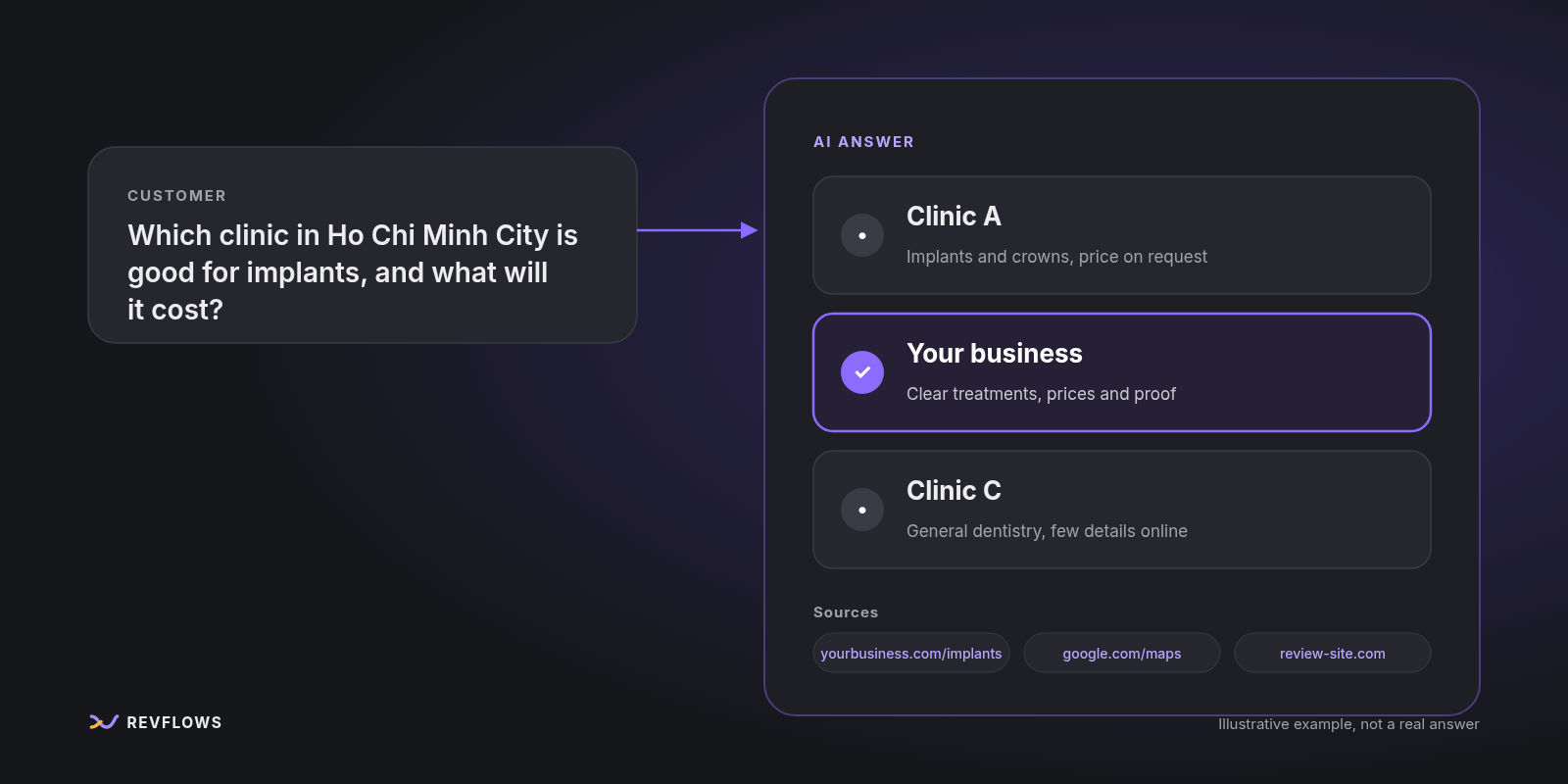
AEO (answer engine optimization) is getting your business named when AI assistants like ChatGPT, Perplexity and Google's AI Overviews answer a customer's question. It builds on SEO. You state clear facts about your business, answer real questions directly, and get other sites to confirm you.
Key takeaways
- Get named inside AI answers, not just ranked in a list of links. That is the goal of AEO.
- Fix the basics first: one fact sheet, the same facts on every site, and crawlers allowed to read your pages.
- Write one page per real customer question, with the answer in the first two sentences.
- Skip special tricks. Google says there is nothing extra to add for AI Overviews beyond good SEO.
- Test the same 10 to 20 questions every month. That is how you know it works.
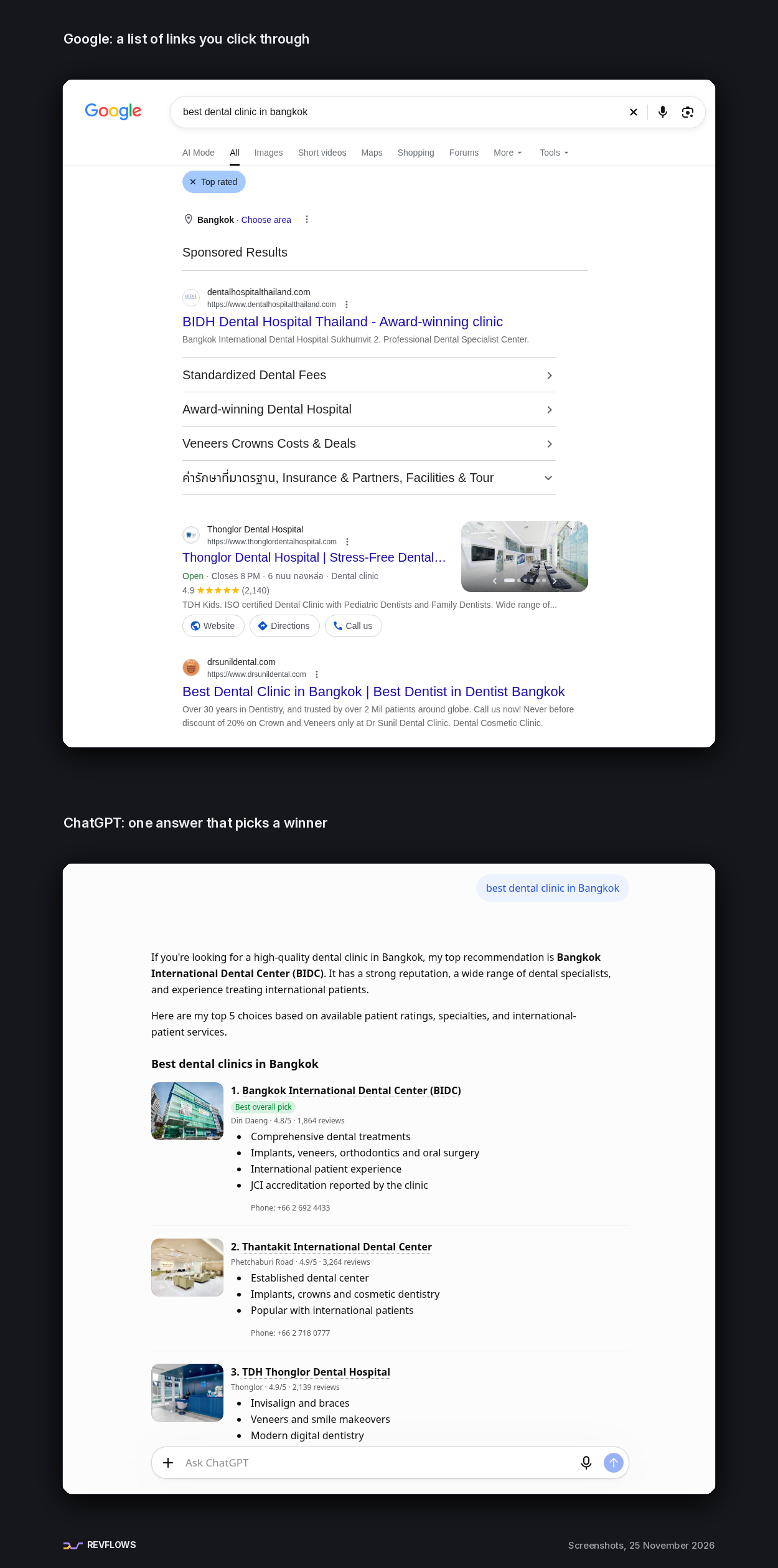
Search for “best dental clinic in Bangkok” and you get two different kinds of result.
On Google, an ad can appear first. When we searched on 25 November 2026 (results set to Thailand), the first listing was a sponsored result for BIDH Dental Hospital, then a map listing for Thonglor Dental Hospital, then an organic page for Dr Sunil. You click through those links to compare.
Ask ChatGPT the same query (we used the logged-out site, same day) and you get one written answer. It called Bangkok International Dental Center (BIDC) its top recommendation and “best overall pick”, then named Thantakit International Dental Center and TDH Thonglor Dental Hospital.
If you are not on that shortlist, you are not in the running. AEO is how you get named.
What is AEO?
AEO stands for answer engine optimization. An answer engine is a tool that replies with a written answer instead of a list of links. ChatGPT search, Perplexity, Gemini, Microsoft Copilot, and Google’s AI Overviews and AI Mode are all answer engines.
AEO is the work of making sure those tools can find your business, understand it without guessing, and trust it enough to name it.
You will also see GEO, AI SEO and LLM SEO. They mean the same thing.
How do AI answers pick which businesses to name?
Every engine works a little differently, and none shares its full rules. The flow is similar:
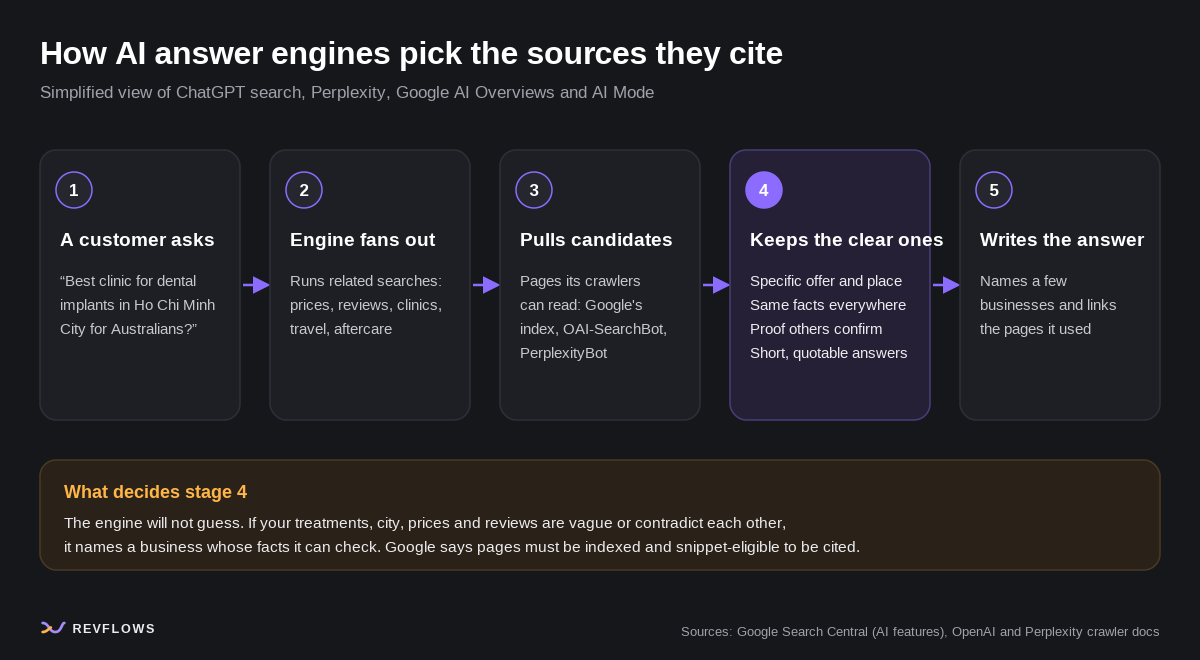
- A customer asks a long, specific question.
- The engine runs several related searches for prices, reviews, places and comparisons. Google calls this “query fan-out” in its AI features guide.
- It pulls pages it can read. A crawler (a program that reads web pages) must be able to reach yours. If it cannot, you are not in the running.
- It keeps the clearest sources. These state a specific offer, place and price, match what other sites say, and answer in a few quotable sentences.
- It writes the answer and links the pages it used.
Step 3 is a switch you control. OpenAI says so directly:
“Sites that are opted out of OAI-SearchBot will not be shown in ChatGPT search answers, though can still appear as navigational links.”
Step 4 is where you win or lose. If your site says “quality dental care” and never says which treatments, where, and for how much, there is nothing specific to quote. The engine names a clinic that does say it. More on this in how ChatGPT decides which business to recommend.
What is the difference between AEO and SEO?
SEO tries to rank a page in a list of links. AEO tries to get your business named inside the answer. Same foundation, different finish line.
| SEO | AEO | |
|---|---|---|
| Goal | Rank a page | Be named or cited in an AI answer |
| Where you appear | Google and Bing results | ChatGPT, Perplexity, Gemini, AI Overviews, AI Mode |
| A win is | A click from the results page | Your business named, with a link |
| Measure | Rankings, clicks | How often you are named, which pages are cited, leads |
| Content | A page per keyword | A page per question, answered up top |
Do I still need SEO?
Yes. Google is clear that nothing extra is needed:
“There are no additional requirements to appear in AI Overviews or AI Mode, nor other special optimizations necessary.”
A page must also be indexed (stored in Google’s search database) and allowed to show a snippet. Slow, blocked or thin pages give AEO nothing to work with.
Google’s Danny Sullivan said the same in a keynote at WordCamp US in August 2025, as reported by Search Engine Land:
“Good SEO is good GEO, or AEO, AIO, LLM SEO, or LMNOPO. So, they’re all fine.”
Our view: this holds for every engine, not only Google. Answer engines pull pages through crawlers and search indexes. If your SEO is broken, AEO cannot fix it. If your SEO is fine, AEO is mostly about being more specific and more consistent than the next business.
What does an AI need to know about your business?
AI tools think in entities: a thing, plus facts about it. Your business is an entity. To name you with confidence, an engine needs your facts stated clearly and confirmed in more than one place.
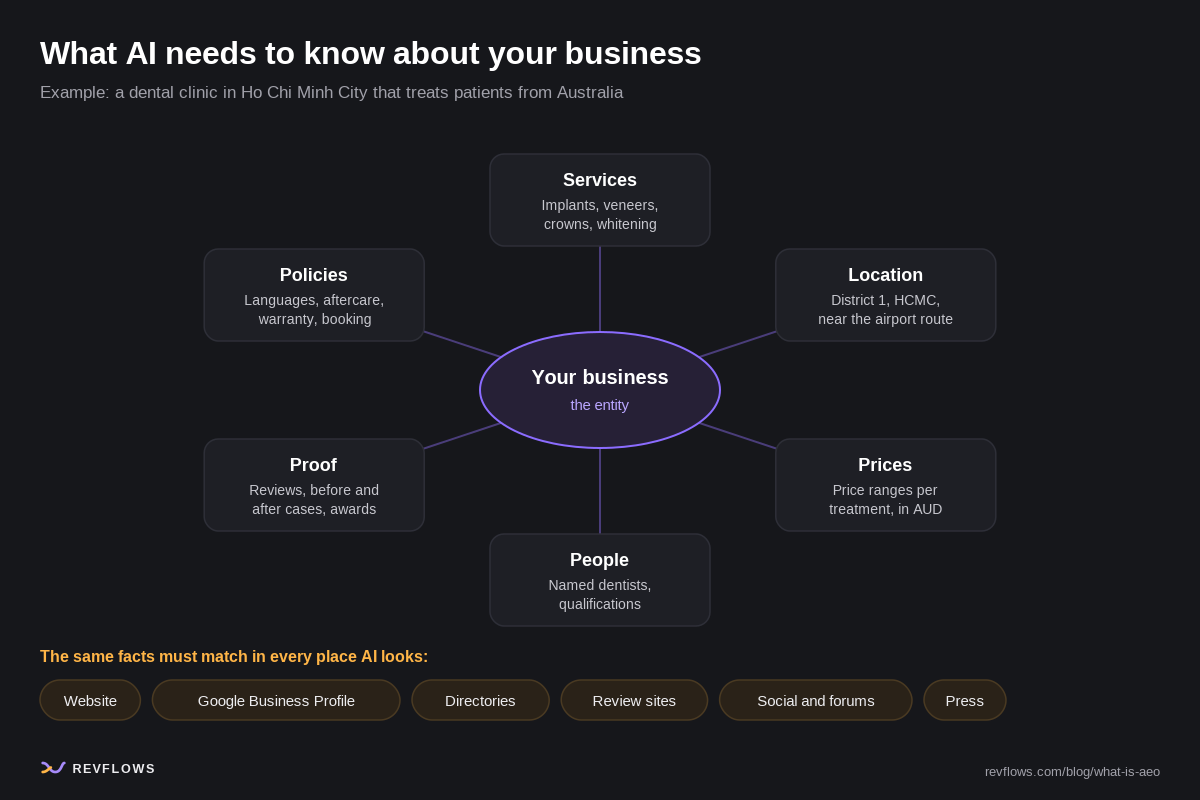
Facts that matter most for a service business:
- Services: named treatments, room types or features, not “our services”.
- Location: city, district, and the countries you serve.
- Prices: a range is fine. A price list inside a PDF that no page mentions does not count.
- People: the named doctors, owners or experts, with qualifications.
- Proof: recent reviews, cases, accreditations.
- Policies: languages, booking, aftercare, cancellation.
Then check that the facts match everywhere. A different name, old hours or a missing service makes an engine less sure, and a less sure engine names someone else.
How do you do AEO? Five steps
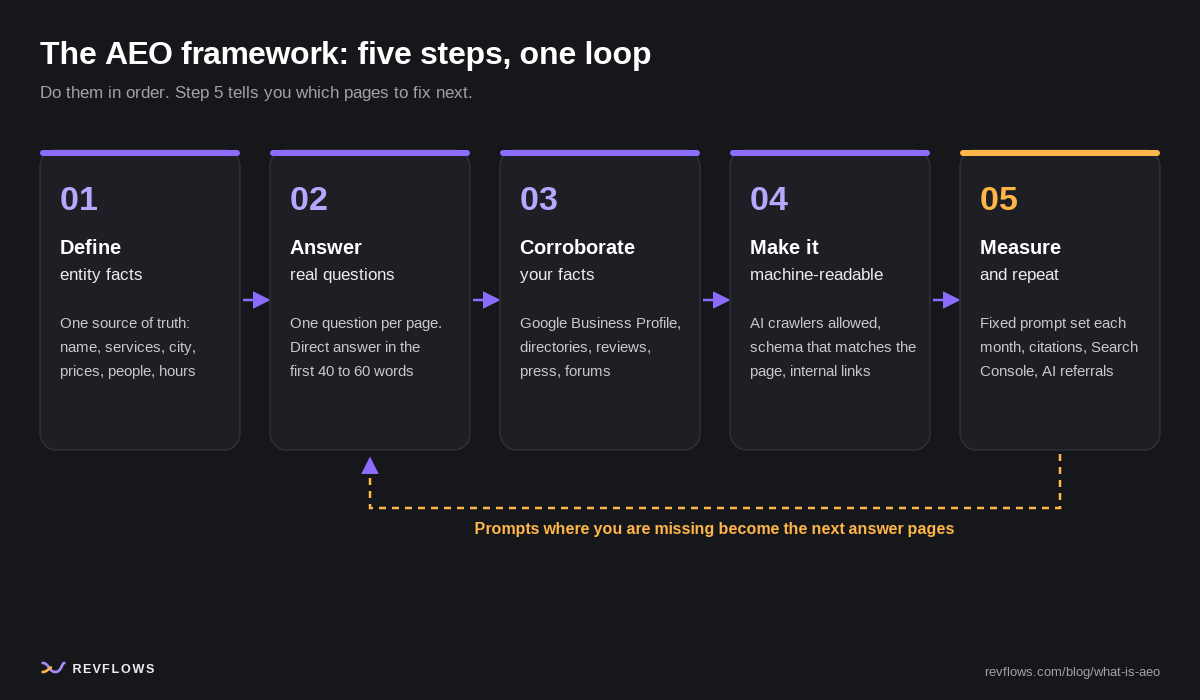
Step 1: Write your fact sheet
Put the facts from the list above on one page: name, services, city, prices, people, hours, languages, how to book. Every website page, profile and listing copies from it.
Done when: you have fixed every place that disagrees with the sheet.
Step 2: Publish answer pages
Write one page per real customer question. Open with a direct answer of 40 to 60 words, the kind an engine can quote. Then add who it is for, what is included, prices, proof and the next step.
“Dental implants with crown for international patients in Ho Chi Minh City” is a page. “Our services” is not.
Don’t stuff keywords. The authors of the GEO research paper (Princeton and IIT Delhi, presented at KDD 2024) tested it on generative engines:
“While widely used for Search Engine Optimization, we find such methods offer little to no improvement on generative engine’s responses.”
In the same paper, adding citations to credible sources, relevant quotations and statistics did best, with up to 40% more visibility in their benchmark. That was a lab test, not a promise. The direction is still useful: claims a reader can check beat claims that only repeat keywords.
Find questions in your sales calls, WhatsApp chats, Google’s “People also ask” boxes and contact forms.
Done when: your five most common sales questions each have a page.
Step 3: Get other sites to confirm your facts
Engines trust what several independent sources agree on. Keep your Google Business Profile complete. Get listed in the directories your industry uses. Ask every customer for a review, not only the happy ones. Answer questions on forums where your customers already ask.
Done when: your name, services and location read the same on at least your site, Google Business Profile and two outside listings.
Step 4: Let crawlers read your site
- Allow Googlebot, Bingbot, OAI-SearchBot and PerplexityBot in robots.txt (a file that tells crawlers which pages they may read).
- Check your firewall too. Perplexity warns that Cloudflare’s Bot Fight Mode can still challenge its bots even when you allow them.
- Add schema (code that labels facts on a page for machines) for your business, services and FAQs. It must match the visible text. Google says no special schema is required, so treat it as housekeeping.
- Link related pages to each other with descriptive link text.
Done when: a test fetch of your key pages works for each crawler, and robots.txt and your firewall agree.
Step 5: Test with the same questions every month
Pick 10 to 20 questions your customers really ask, with your city and service in them. Ask them in ChatGPT, Perplexity, Gemini and Google. Write down who is named, which pages are linked, and whether you appear.
Every question where you are missing becomes a new page in step 2. See our guide to measuring AI search visibility.
Done when: you have a sheet with the same questions, dated results, and a list of gaps.
What does AEO look like for a clinic, a hotel or a SaaS company?
The steps are the same. The first page you write differs. These are examples, not client results.
- Dental clinic in Ho Chi Minh City, serving Australians: a page on implant cost in AUD, with the dentist’s name and qualifications. See Revflows for clinics.
- Boutique hotel in Bali or Phuket: a page on airport transfers and whether booking direct is cheaper, with the same room facts as on booking sites. See Revflows for hotels.
- SaaS company in Singapore or Sydney: an honest comparison page and a clear pricing page, plus listings on the review sites buyers use. See Revflows for SaaS.
How do you measure AEO results?
Track three numbers, monthly:
- How often you are named in your fixed set of questions.
- Which of your pages are linked, and for which questions.
- Leads from AI. Google counts clicks from AI Overviews and AI Mode inside the normal “Web” results in Search Console, as its AI features guide explains. Visits from ChatGPT and Perplexity usually show as referrals in your analytics.
Rankings still matter as an early signal, because the engines pull from search indexes.
How long does AEO take?
Access is fast. OpenAI and Perplexity both say a robots.txt change takes about 24 hours to apply. Reputation is slow. Google says recrawling can take “anywhere from several days to several months”, and reviews and mentions take as long as they take to earn.
Plan for months. Judge progress over a quarter, not a week.
Our view: what to do first, and what to skip
- Do the fact sheet before you buy any tool. A tracking tool tells you that you are missing. It does not give you the facts to be found.
- Write for the customer who asked, not for the AI. Pages built around a real question read well to people and to engines. Pages built around a tool’s checklist read like a checklist.
- Count enquiries, not only mentions. Being named is a means. Calls, bookings and sign-ups are the result. Tag where each enquiry came from, and ask new customers how they found you.
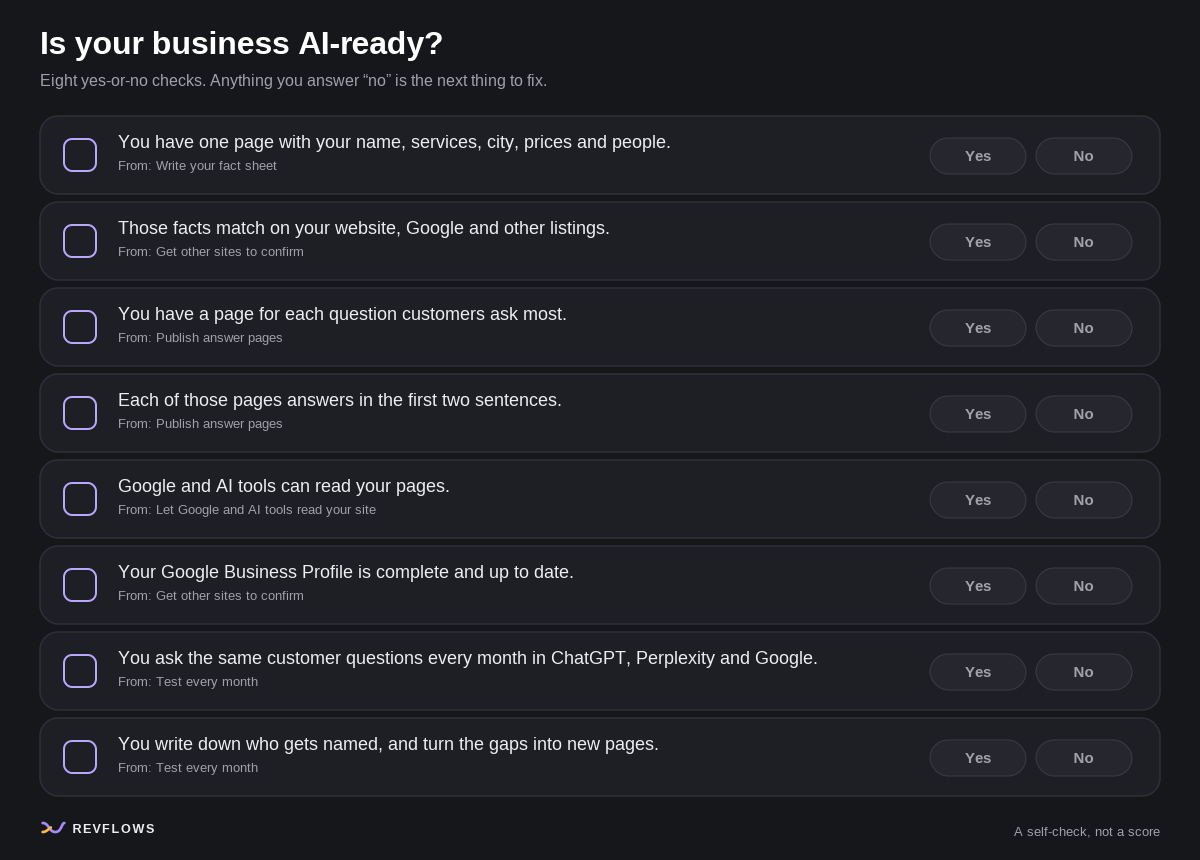
Is your business AI-ready?
Work through this list. Anything you answer “no” is the next thing to fix. The checks follow the five steps above.
Can you do AEO yourself?
Yes. Steps 1, 2 and 5 need time more than tools. Start with this week’s list:
- Write the fact sheet and fix every place that disagrees with it.
- Turn your five most common sales questions into five pages.
- Check that robots.txt and your firewall allow Googlebot, OAI-SearchBot and PerplexityBot.
- Ask 10 customer questions in ChatGPT, Perplexity and Google, and note who is named.
Get help when you have the questions but not the time to write and maintain the pages, when you serve several markets or languages, or when you want the monthly tracking done for you. That is what our managed AEO service does. The AI employees in our AI automation work then answer the enquiries AEO brings in.
Check where you stand
Free AI visibility check. Answer a few questions about your business and see where AI assistants are likely to skip you, and what to fix first.
Questions
What does AEO stand for in marketing?
AEO stands for answer engine optimization. It means making your business easy for AI assistants and AI search features to find, trust and name when they answer a customer's question.
Is AEO the same as SEO?
No, but it depends on SEO. SEO aims to rank a page in a list of links. AEO aims to get your business named inside an AI-written answer. Google says the same SEO basics apply to its AI features, so a crawlable, indexed site comes first.
Is AEO the same as GEO?
Almost. GEO (generative engine optimization) is the term used in academic research. AEO is the term most marketers use. AI SEO and LLM SEO mean the same work. Pick one name and focus on the steps.
Do I need an llms.txt file for AEO?
No. Google says you do not need new machine-readable files, AI text files or special schema to appear in AI Overviews or AI Mode. An llms.txt file is cheap to add, but clear pages and consistent facts matter far more.
How long does AEO take to work?
Access changes are quick: OpenAI and Perplexity say robots.txt updates take about 24 hours. Content and reputation changes take months, because pages must be recrawled and other sites need time to mention you. Measure monthly.
How can I check whether ChatGPT recommends my business?
Write 10 to 20 questions your customers really ask, with your city and service in them. Ask them in ChatGPT, Perplexity, Gemini and Google. Record who is named and which pages are linked. Repeat monthly with the same questions.