AI-Era Visibility · ChatGPT · AEO · Local search · AI search
How to get your business recommended by ChatGPT
 Eimantas KazėnasFounder, RevflowsUpdated Published
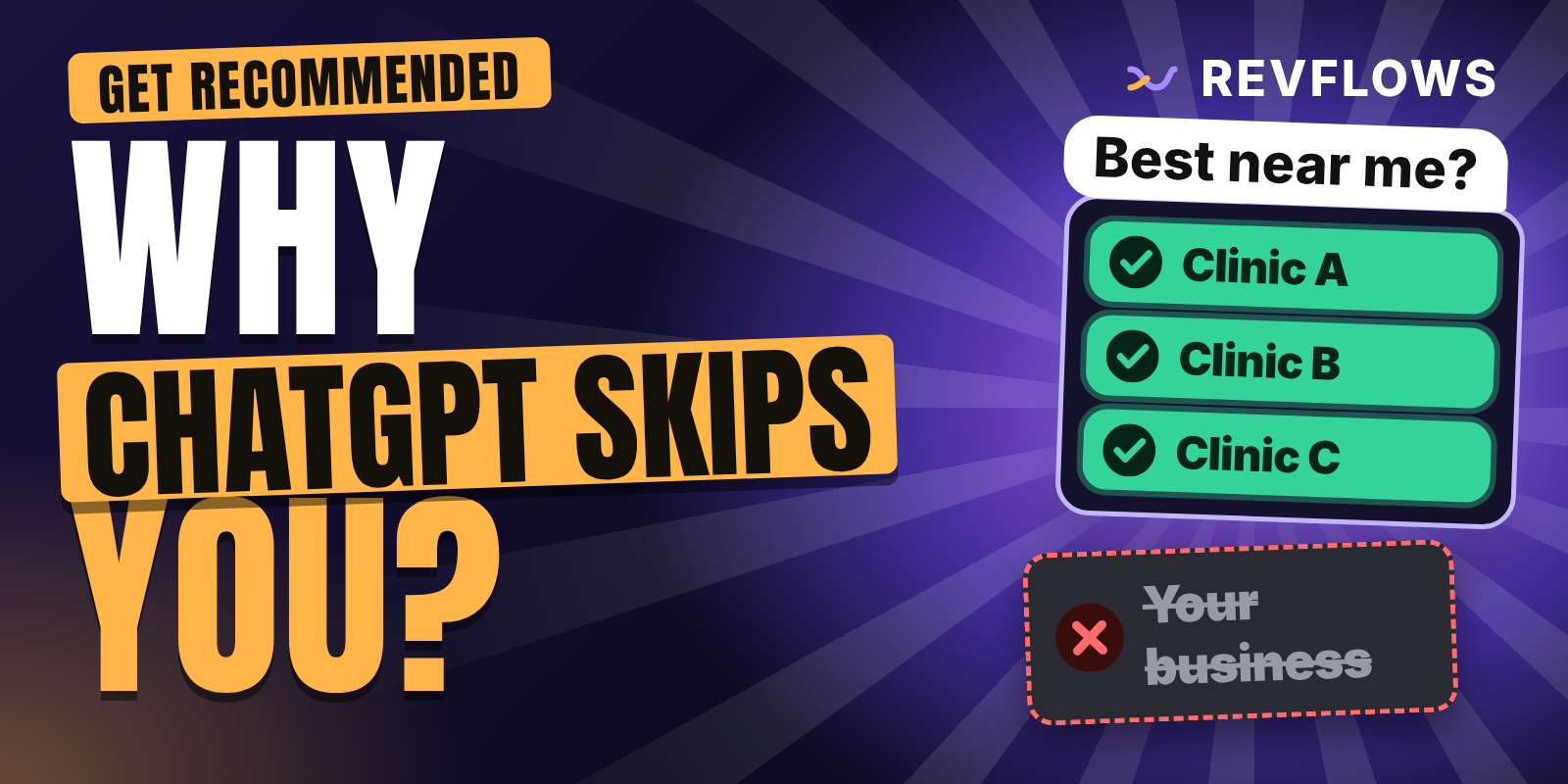
ChatGPT recommends businesses it can find through web search, that state clear facts about their services, place and prices, and that other sites confirm. To get recommended, let OpenAI's search crawler read your site, make your Google and Bing listings match your website, publish a page for each real customer question, and earn recent reviews.
Key takeaways
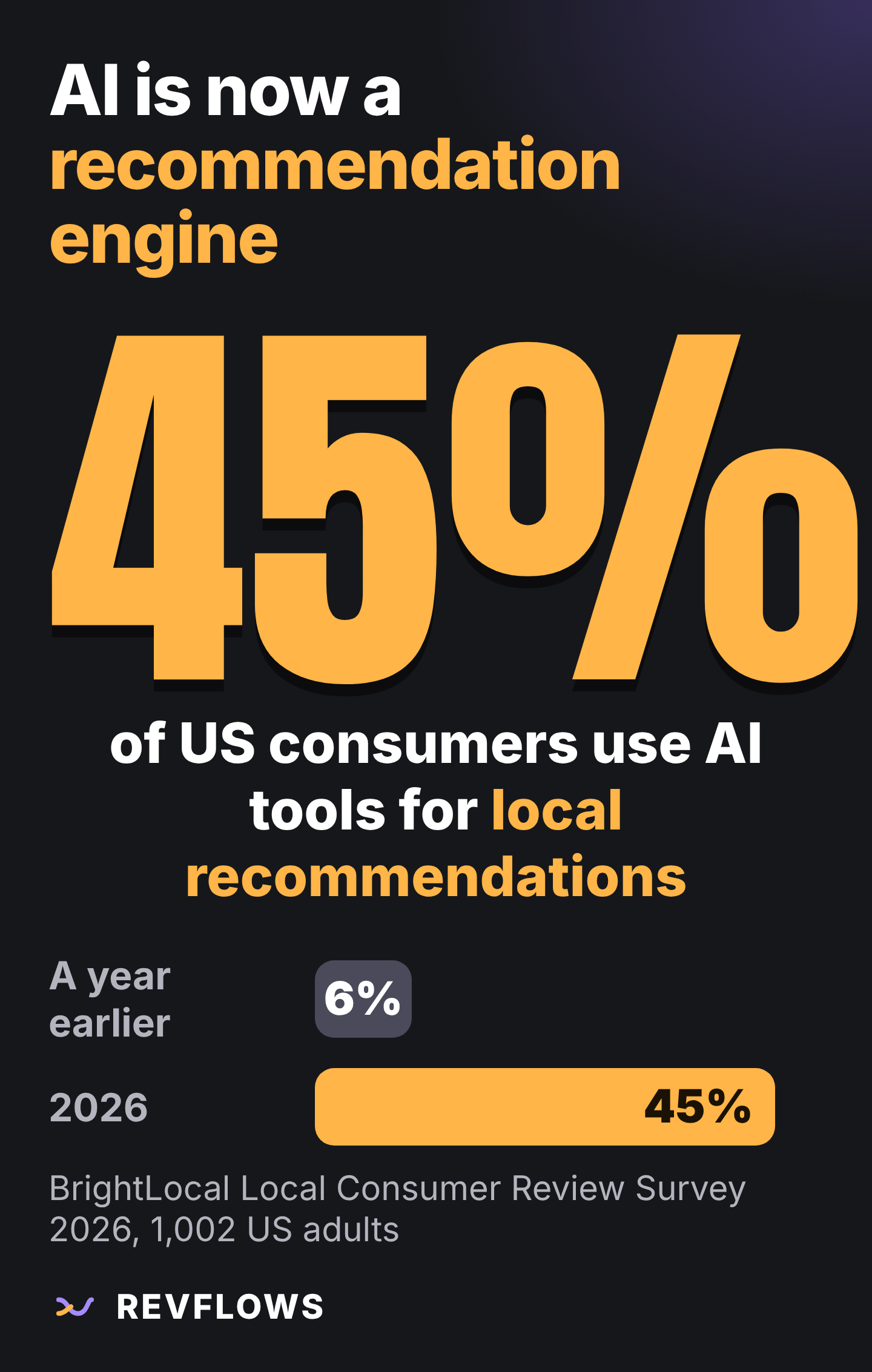
- 45% of US consumers in BrightLocal's 2026 survey use AI tools like ChatGPT for local recommendations, up from 6% a year earlier.
- ChatGPT can only name you if OAI-SearchBot can read your site. Check robots.txt and your firewall.
- Make your Google Business Profile and Bing Places listing match your website, word for word.
- Publish one page per real customer question, with service, city and price up top.
- Answers change every time. Test each question several times, every month.
Your next customer may never see a list of links. They ask ChatGPT, and ChatGPT names three businesses.
That habit is growing fast. BrightLocal’s 2026 survey of 1,002 US consumers found:
“Use of ChatGPT and other generative AI tools for local recommendations has grown rapidly, rising from 6% last year to 45% and becoming the third most popular source of business recommendations.”
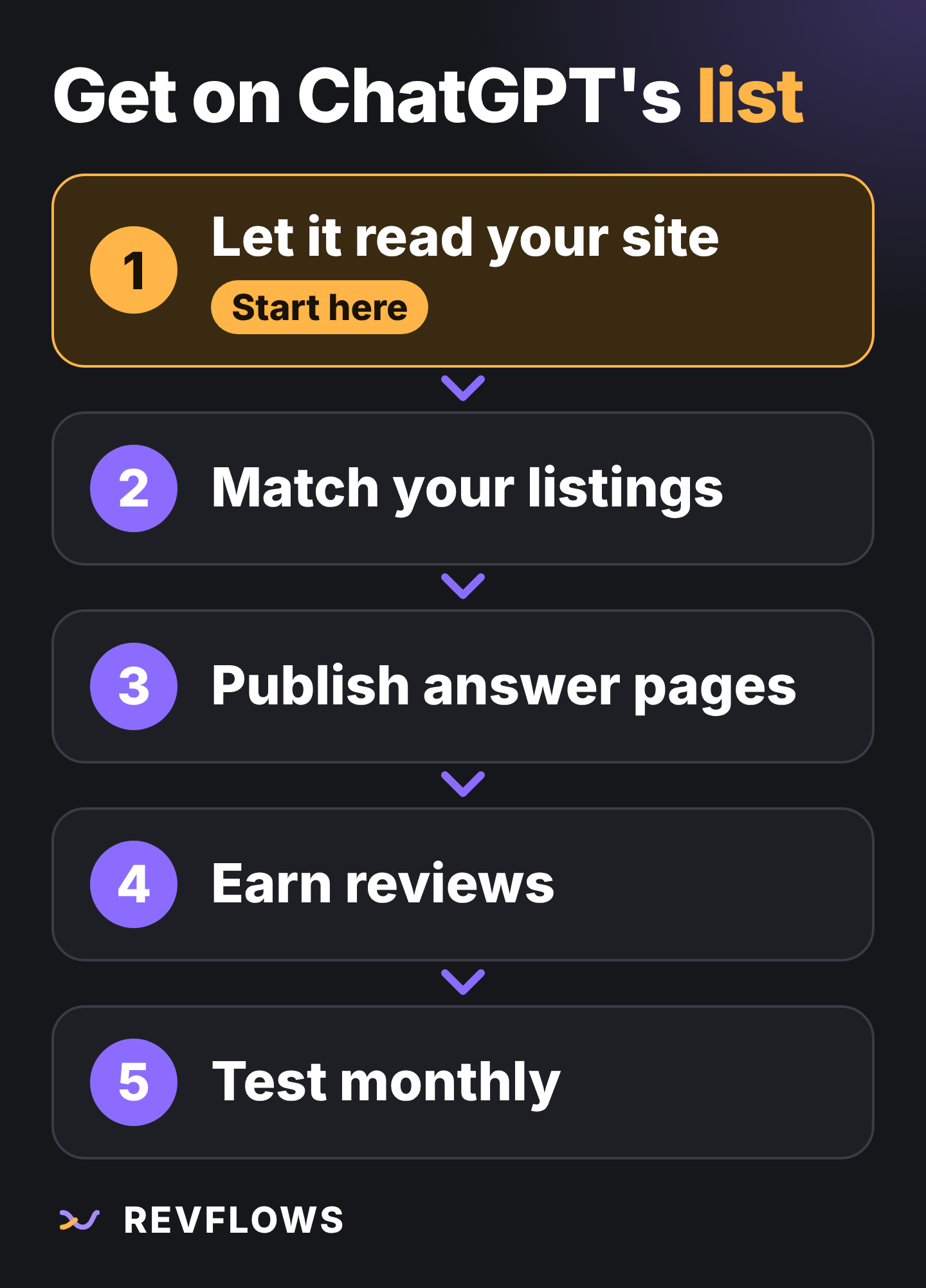
To get your business recommended by ChatGPT, make it easy to find, easy to understand and easy to confirm. Let OpenAI’s crawler read your site, make your listings match, publish clear answer pages, earn reviews, and test monthly.
This guide applies the ideas in what is AEO to ChatGPT.
How does ChatGPT decide which business to recommend?
OpenAI does not publish its full rules. Its help pages explain enough to act on.
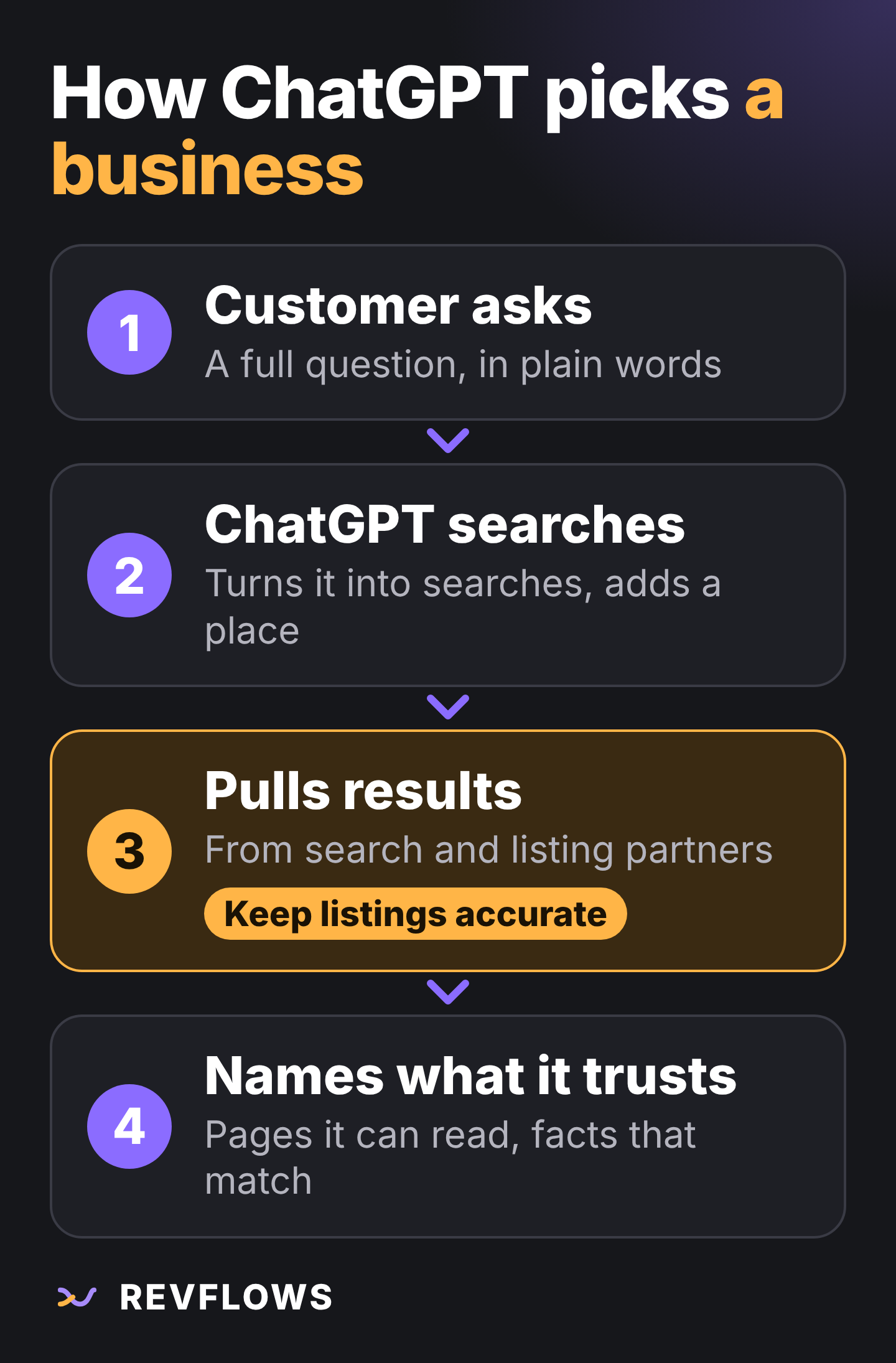
1. It turns the question into searches. OpenAI’s example: someone in San Francisco asks for “good restaurants near me”, and ChatGPT may search for “top restaurants San Francisco”. It uses a rough location from the IP address, per its web search help page.
2. It pulls results from partners. The same page says ChatGPT search partners with third-party search providers. It links to Microsoft’s and Shopify’s privacy policies. For local questions, it may use providers of “nearby business listings”.
3. It reads the pages it can reach. OpenAI’s search crawler is called OAI-SearchBot. If your site blocks it, your pages can’t be used in the answer.
4. It picks the most useful sources. OpenAI puts it like this:
“ChatGPT ranks search results using multiple factors intended to help users find relevant, reliable information. Placement is not guaranteed.”
Relevant means your page matches the question: the service, the place, the budget. Reliable means other sources agree with you. The five steps below cover both.
Step 1: Let ChatGPT read your site
Check your robots.txt file (yoursite.com/robots.txt, the file that tells crawlers what they may read). OAI-SearchBot must not be blocked.
OpenAI also asks site owners to allow traffic from its published IP addresses. Security tools at your host or CDN can block it without you knowing. Ask whoever runs your hosting.
You can block GPTBot, which collects data for model training, and still allow OAI-SearchBot. OpenAI treats them as separate settings. Changes take about 24 hours.
Step 2: Make your listings match your website
For local questions, AI tools lean on business listings. Two matter most.
Google Business Profile. Google says local results depend mainly on relevance, distance and how well known a business is, and that complete, accurate info helps, per its local ranking help page. A complete profile is also a public record any AI tool can check.
Bing Places. ChatGPT’s help page lists Microsoft’s privacy statement among its search providers, and Bing’s index powers Microsoft Copilot. Microsoft says:
“businesses can register with Bing Places for Business to help ensure that key details such as address, hours, and contact information remain current and eligible for inclusion in AI-generated responses.”
Make these match your website exactly:
- Business name, written the same way
- Address and service area
- Phone, hours and booking link
- Main services, in the words customers use
- Price ranges, where you can share them
Then do the same on the directories your industry uses: health directories for clinics, travel sites for hotels, software review sites for SaaS.
Step 3: Publish pages that match how people ask
People type short keywords into Google. They ask ChatGPT full questions.
| A Google search | A ChatGPT question |
|---|---|
| dentist bangkok | Which dental clinic in Bangkok is good for implants, speaks English, and costs under AUD 3,000? |
| hotel phuket | Quiet family hotel in Phuket near Kata Beach with a kids’ pool, under USD 150 a night? |
| crm software | Best CRM for a 10-person agency in Singapore that works with WhatsApp? |
To be named for questions like these, your site needs pages that answer them. One page per service and per common question. Put the answer, the place and the price range in the first two sentences.
Before and after (a hypothetical clinic page):
- Before: “We offer world-class dental care with a caring, experienced team.”
- After: “We place dental implants in Bangkok for patients flying in from Australia. Treatment takes two visits, 4 to 6 months apart. A single implant with crown costs AUD 1,900 to 2,600. Our implant surgeon, Dr Somchai, has placed implants for 12 years.”
The first gives ChatGPT nothing to repeat. The second answers the customer’s question in four sentences. (Names and prices are examples.)
For the full page checklist, see AI search optimization.
Step 4: Earn reviews and mentions on other sites
AI tools trust what several sources agree on. Reviews are the easiest way to build that agreement.
BrightLocal’s 2026 survey advice for local businesses: keep your website up to date, monitor your business listings, build citations on relevant local and niche sites, and check the sources AI tools reference. If something is wrong, ask for a correction, per the same survey.
In practice:
- Ask every customer for a review, every week. Not only the happy ones.
- Reply to reviews. It shows the business is active.
- Get listed where your customers compare options.
- Answer questions in forums and groups your customers already use.
Never buy or fake reviews. It breaks platform rules, and BrightLocal found 57% of consumers think businesses caught faking reviews should be banned from review platforms.
Step 5: Test like a customer, every month
Write 10 to 20 questions your customers really ask, with your city and service in them. Ask them in ChatGPT. Record who is named, in what order, and which pages are linked.
Ask each question more than once. AI answers change from run to run. In SparkToro’s research, there was less than a 1 in 100 chance that ChatGPT, asked the same question 100 times, would give the same list of brands in any two answers, per Rand Fishkin’s write-up. One screenshot proves nothing. A pattern over many runs does.
Every question where you are missing becomes a new page or a listing fix. Our guide to measuring AI search visibility gives you a simple scorecard.
What doesn’t work
- Paying for a spot in the answer. ChatGPT has ads, checked by a separate OpenAI crawler called OAI-AdsBot. That’s advertising. The answer itself is ranked, and OpenAI says placement is not guaranteed.
- Vague “best in town” pages. Claims with no service, place, price or proof give the AI nothing to quote.
- Fixing your website but not your listings. If Google, Bing and your site disagree, you look less reliable.
Our view
- Start with access and listings. They take a day and remove the most common reasons ChatGPT skips a business.
- Write the page your best customer wishes existed. Specific, priced, honest. That page wins with people and with AI.
- Count enquiries, not screenshots. Add “ChatGPT or another AI tool” as an option in your “How did you hear about us?” question.
Check where you stand
Free AI visibility check. Answer a few questions about your business and see where AI assistants are likely to skip you, and what to fix first.
Questions
How does ChatGPT decide which businesses to recommend?
When ChatGPT searches the web, it rewrites the question into search queries, can add your general location, and pulls results from search partners and local listing providers. It then names businesses from sources it can read. OpenAI says it ranks results on factors meant to find relevant, reliable information, and that placement is not guaranteed.
Can I pay ChatGPT to recommend my business?
You can buy an ad, not a recommendation. OpenAI runs ads on ChatGPT and checks ad landing pages with a separate crawler, OAI-AdsBot. The search results are ranked on relevance and reliability, and OpenAI says placement is not guaranteed.
Why does ChatGPT recommend my competitors and not me?
Usually one of four reasons: OpenAI's crawler is blocked from your site, your pages don't state your services, place and prices clearly, your listings disagree with your website, or competitors have more recent reviews and mentions on other sites.
Does ChatGPT use Google to find businesses?
OpenAI does not publish a full list of its sources. Its help page says ChatGPT search partners with third-party search providers and links to Microsoft's and Shopify's privacy policies, and that it may use providers of nearby business listings. Keep both your Google and Bing listings accurate.
How long does it take to get recommended by ChatGPT?
Access fixes apply fast: OpenAI says robots.txt changes take about 24 hours. Content, listings and reviews take weeks to months, because other sites need time to update and confirm your facts. Test monthly.