AI Systems · Web design · Website cost · Small business · How-to
How much does a website cost in 2026? Real price ranges
 Eimantas KazėnasFounder, RevflowsUpdated Published
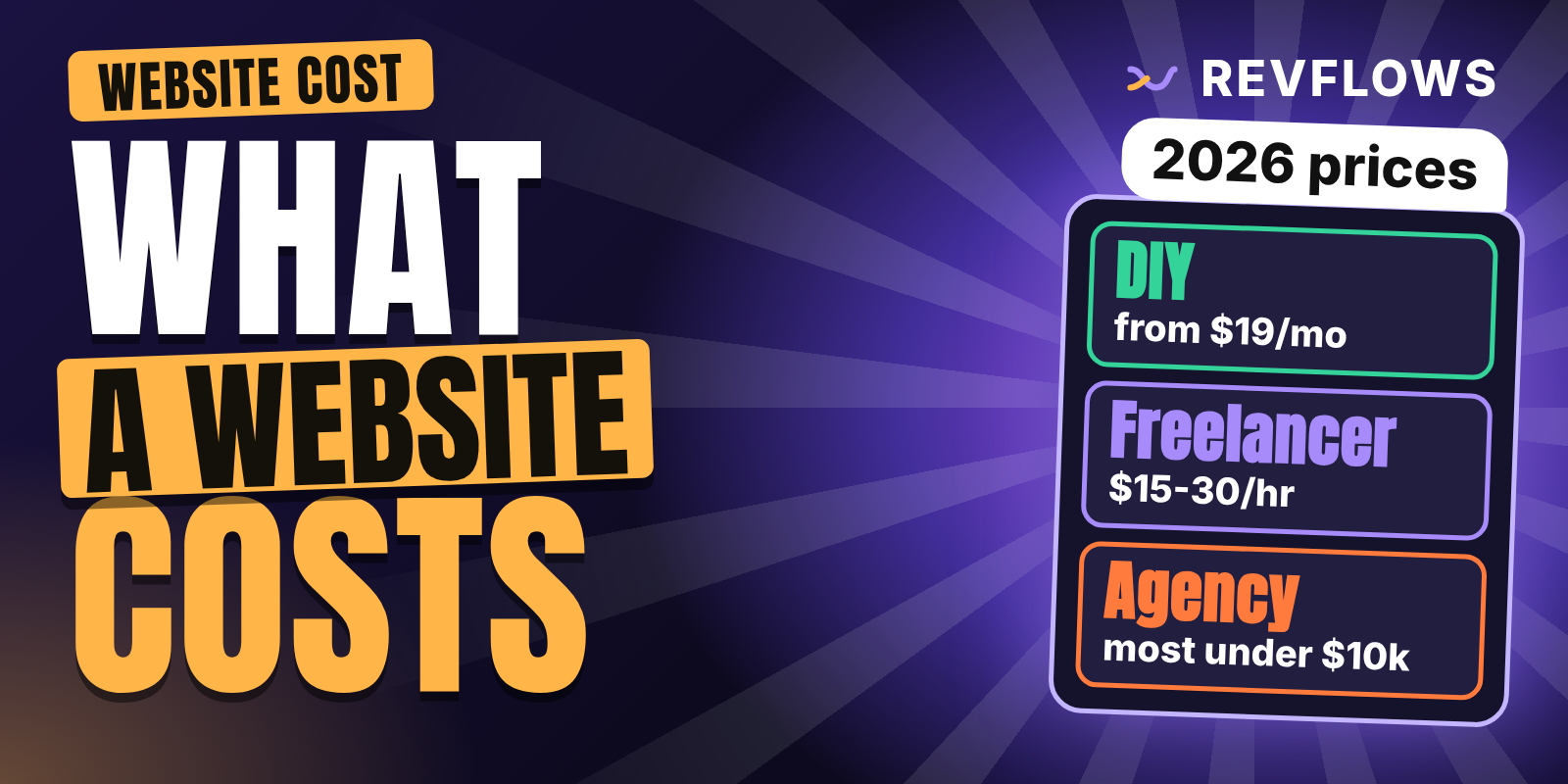
A small business website costs anything from a few hundred dollars a year with a website builder you set up yourself, to a few thousand with a freelancer, to $2,000 to $100,000 with an agency, where most projects reviewed on Clutch come in under $10,000. Budget for running costs too: domain, hosting or plan fees, updates and content changes.
Key takeaways
- Three ways to get a site: do it yourself on a builder, hire a freelancer, or hire an agency.
- Builders start at $19 a month (Squarespace Basic, billed yearly). Freelance web designers on Upwork charge a median $15 to $30 an hour.
- Agencies charge $2,000 to $100,000, and most projects reviewed on Clutch cost less than $10,000.
- Running costs never stop: domain, hosting or plan, updates, backups and content changes.
- Compare the cost over 3 years, not the launch price.
“How much does a website cost?” gets the most annoying answer in business: it depends. It does. But it depends on a short list of things you can control, and the price bands are not a secret.
This guide gives you real 2026 ranges, from published price lists and marketplace data, for the three ways to get a website. Then it covers the costs most quotes leave out: redesigns, maintenance and the yearly bills.
It is one part of our guide to web design for small business, which covers what a site needs to do before you spend anything.
What drives the price of a website
Four things set the price, in this order:
- Scope. How many pages, and which features: booking, payments, several languages, a members area, connections to your CRM.
- Who builds it. You, a freelancer or an agency. Hourly rates differ by up to about 10 times.
- Platform. A website builder, WordPress or a modern framework like Astro. This mostly changes the running cost.
- Content. Who writes the text and supplies the photos. If the builder does it, the price goes up, and so does the quality, usually.
Design style matters less than people think. A clean site with clear pages costs less to build and usually sells better than a fancy one.
The 3 ways to get a website, and what each costs
1. Do it yourself on a website builder
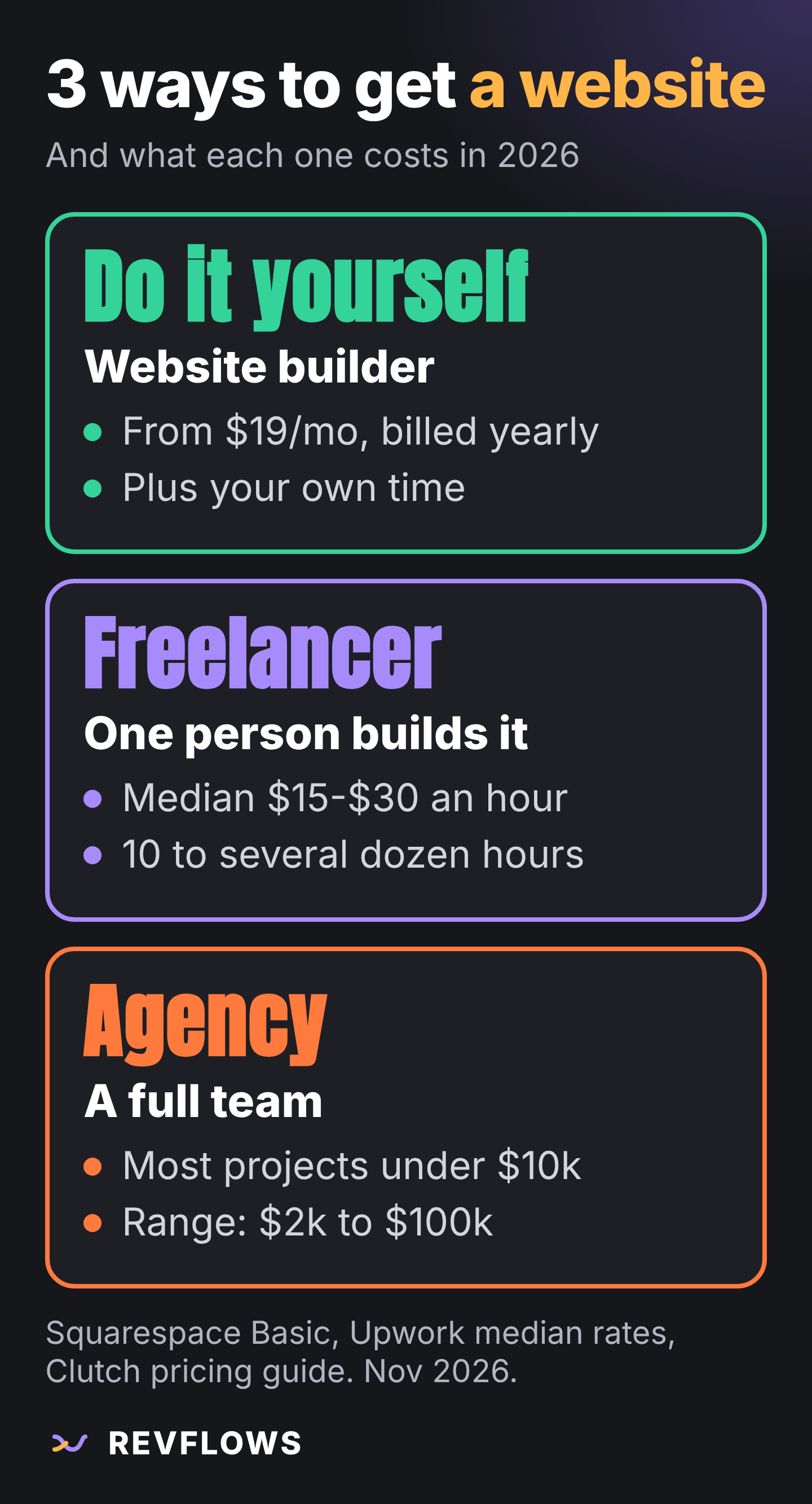
You pick a template on a builder like Squarespace, Wix or Shopify and fill it in. Hosting is included in the plan.
What it costs: Squarespace’s Basic plan is $19 a month billed yearly, or $25 month to month, and annual plans include a free domain for the first year. That is $228 a year before your time. Plans with more selling features cost more.
Good for: a first site, a small shop, a tight budget. The hidden cost: your time. Writing, design choices, photos and updates all land on you. Moving away later can also be hard.
2. Hire a freelancer
A freelance web designer builds the site for you, often on WordPress or a builder.
What it costs: Upwork puts the median hourly rate for web designers at $15 to $30. Its guide gives typical ranges of $15 to $40+ an hour for a basic one-page site, $20 to $50+ for a CMS theme like WordPress, and $45 to $75+ for a fully custom design. It expects anywhere from 10 hours for a very small project to several dozen hours for a large custom one.
So a small site from a freelancer usually lands somewhere between a few hundred and a few thousand dollars, depending on rate and hours.
Good for: a clear, small project where you already know what you want. Watch out for: who looks after the site after launch, and who owns the logins.
3. Hire an agency
An agency gives you a team: strategy, design, build, often copy and SEO.
What it costs: Clutch’s web design pricing guide, based on verified client reviews, says agencies typically charge $2,000 to $100,000. Most projects reviewed on Clutch cost less than $10,000. Agencies shortlisted on Clutch charge around $100 to $149 an hour.
Clutch also reports an average project cost of $38,105, but large projects pull that average up. For a small business, “most projects under $10,000” is the more useful number.
Good for: when the website is a main source of sales, or you need strategy, copy and integrations as well as design. Watch out for: scope creep. Get the price split into parts, and agree in writing what counts as a change.
Hourly rates compared
The same hour of work can cost up to about 10 times more depending on who does it:
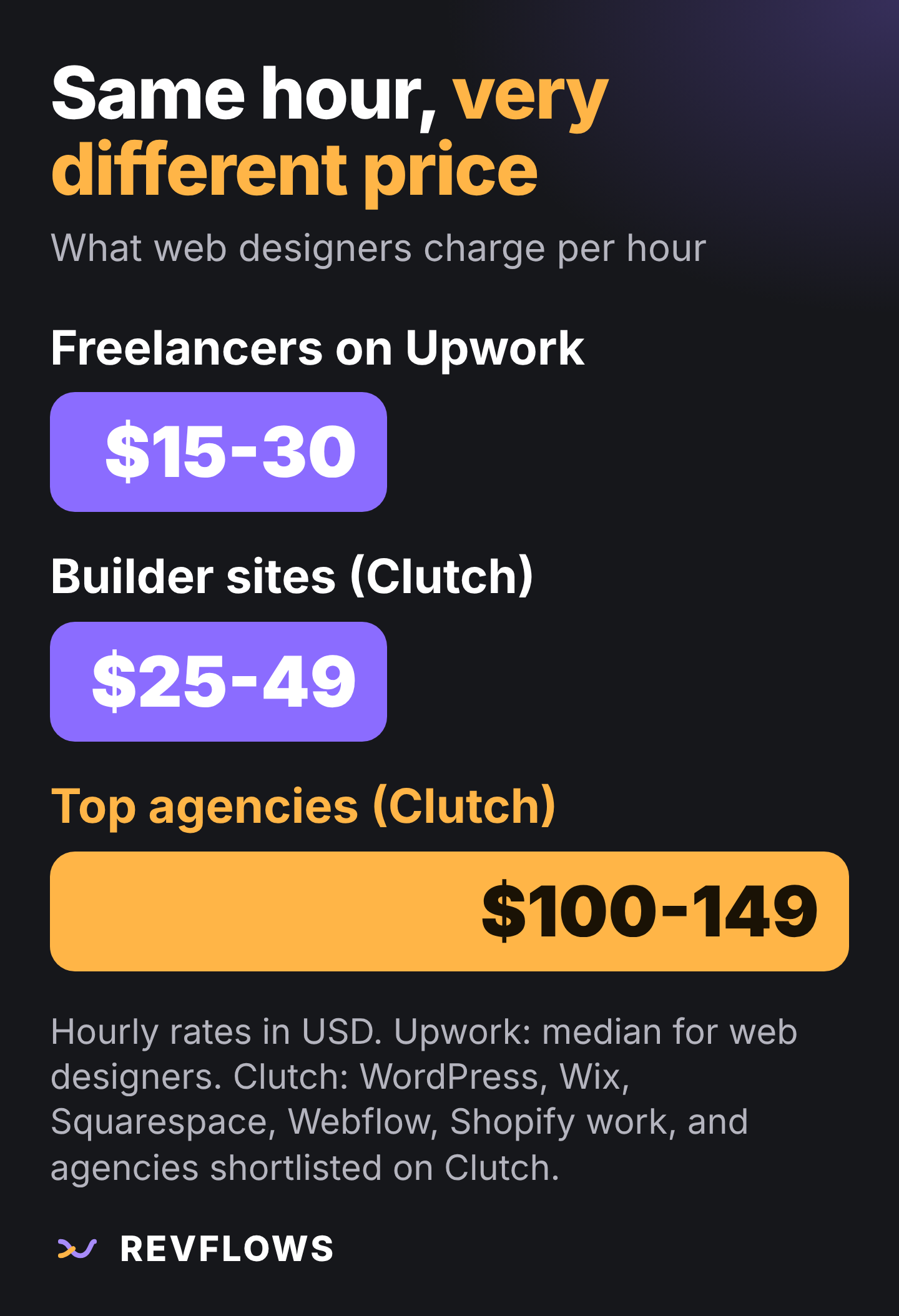
A higher rate isn’t automatically a worse deal. An experienced team often finishes in fewer hours and gets it right the first time. Compare total price for the same brief, not rates.
What a website costs to run every year
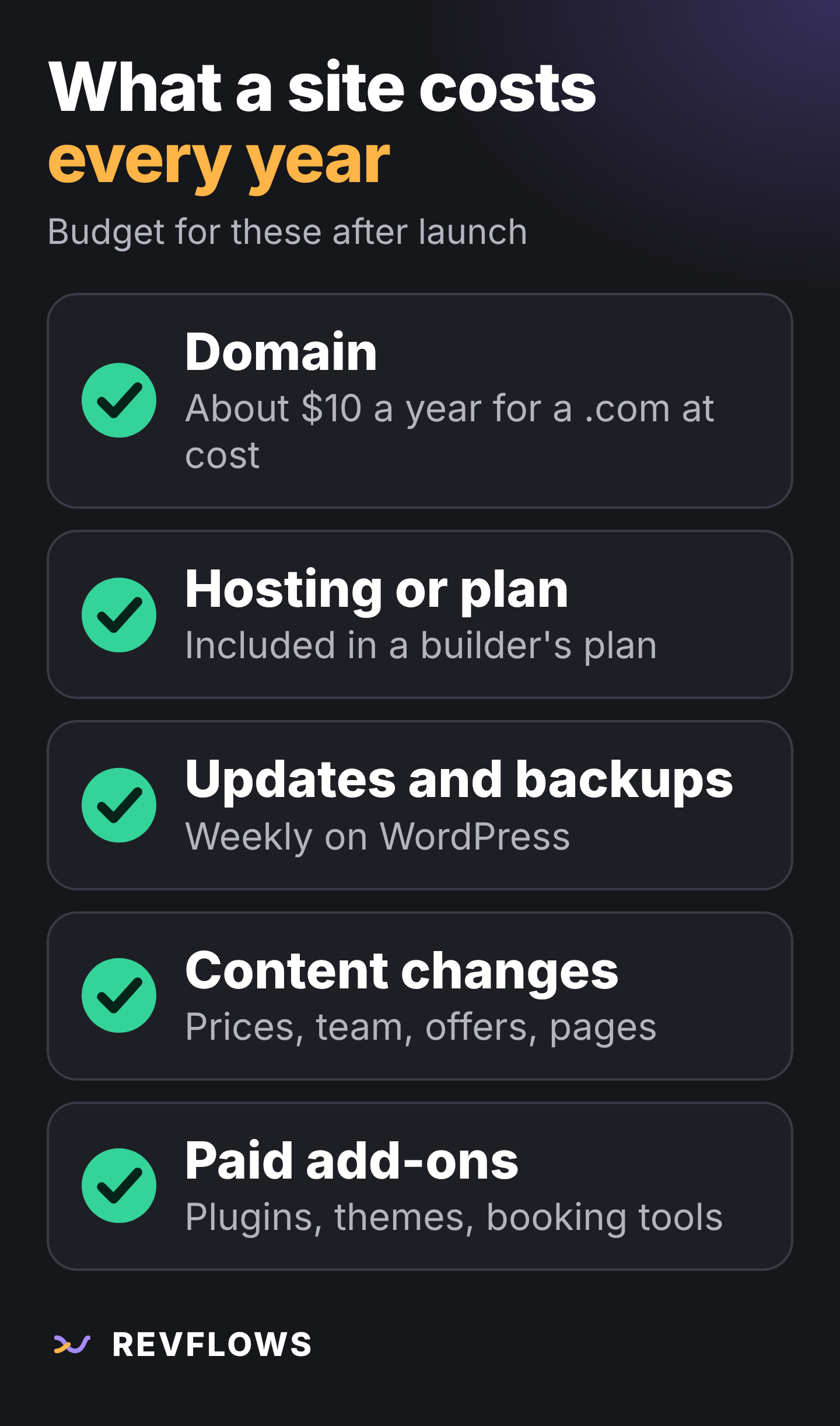
The launch price is only the start. Every website has running costs:
- Domain. A .com domain costs about $10 a year at cost-price registrars. Cloudflare Registrar, for example, sells domains at the price the registry charges, with no markup.
- Hosting or builder plan. Included in a builder’s plan. Separate for WordPress or a custom site.
- Updates and backups. Small on a builder, weekly on WordPress, rare on a static site.
- Content changes. New prices, team members, offers and pages.
- Paid add-ons. Premium plugins, themes, booking tools and email tools.
Website maintenance cost
Maintenance is where platforms differ most.
On a builder, the platform handles hosting, security and updates. You pay the plan.
On WordPress, someone needs to apply updates every week. Patchstack’s State of WordPress Security in 2026 found that the most heavily targeted vulnerabilities were attacked within a median of 5 hours, and 91% of new ones were in plugins. That is why WordPress care is usually a monthly retainer or a few paid hours a month.
To estimate it: multiply the hours a month by the hourly rate. For example, 2 hours a month at Clutch’s $25 to $49 range for WordPress work would be $50 to $98 a month. Your real number depends on how many plugins you run and how often things break.
A static site built with a framework like Astro has far less to update, because there are no plugins running on the server. We compare the two in Astro vs WordPress for a business website.
How much does a website redesign cost?
A redesign is priced like a new build: by pages, features and who builds it. The same bands apply.
But add one line many quotes miss: protecting your search rankings. A redesign that changes page addresses without redirects can wipe out years of traffic in weeks. Budget time for:
- listing every current URL,
- mapping each one to a new address and setting up 301 redirects,
- keeping the text that already ranks,
- watching Google Search Console after launch.
The full checklist is coming in website redesign without losing SEO.
Cheap vs expensive: what you actually get
Price differences are real, but not always where you expect:
| You pay less | You pay more |
|---|---|
| A template filled in with your text | A layout built around what your customers need to see |
| You write and source everything | Copy and photos planned for you |
| Few pages, one contact form | One page per service, booking, payments, CRM connections |
| You handle updates and fixes | Someone owns speed, security and updates |
| Launch, then nothing | Tracking set up, so you know what the site sells |
The expensive mistakes are rarely “paid too much for design”. They are a slow site, no page per service, broken redirects, and a site nobody looks after.
How to get an accurate website quote: 5 steps
1. Write down what the site must do. The one action you want (book, buy, call, inquire) and the tools it must connect to.
2. List every page and feature. One page per service, plus home, prices, about, contact and FAQ. Add booking, payments or languages if needed.
3. Decide who writes and supplies content. If the builder writes or sources it, it should be in the quote.
4. Send the same brief to two or three builders. Ask each to split the price into design, build, content and yearly running cost.
5. Compare the 3-year cost. Build price plus three years of hosting, plan fees, updates and changes.
Questions to ask before you sign
- Who owns the domain, the hosting account and the site files? It should be you.
- What happens after launch? Who applies updates, and what does it cost?
- Is copy included? How many rounds of changes?
- How fast will it load on a phone? Ask for Google’s Core Web Vitals targets in writing.
- If you replace an old site: who sets up the redirects?
Our view
- Pay for clarity and speed, not decoration. A fast, clear site with a page per service outsells a pretty, slow one.
- Own your accounts. Domain, hosting and logins in your name, always.
- Price the whole life of the site. The 3-year cost tells you more than the launch quote.
Get a clear quote for a fast site
Want a fixed price for a fast site that sells? We build business websites on modern stacks like Astro, keep your rankings when you move, and quote the build and the running cost up front.
Questions
How much does a website cost for a small business?
It depends on who builds it. Setting it up yourself on a website builder costs the plan fee, from $19 a month on Squarespace's Basic plan billed yearly, plus your time. A freelancer typically costs a few hundred to a few thousand dollars. Agencies charge $2,000 to $100,000, and most projects reviewed on Clutch cost less than $10,000.
How much does it cost to build a website yourself?
On a website builder you pay a monthly or yearly plan that includes hosting, plus a domain. Squarespace's Basic plan is $19 a month billed yearly or $25 month to month, and annual plans include a free domain for the first year. The real cost is your time to write, design and keep it updated.
How much does a website redesign cost?
A redesign is priced like a new build: by pages, features and who does the work. Add the cost of protecting your search rankings: listing every old URL, setting up 301 redirects and checking Search Console after launch. Skipping that step is the most expensive mistake in a redesign.
How much does website maintenance cost?
It depends on the platform. A website builder includes hosting and updates in the plan fee. A WordPress site needs someone to apply plugin and core updates every week, take backups and fix what breaks, usually paid by the hour or as a monthly retainer. A static site built with a framework like Astro needs far fewer updates.
Is there a monthly fee to have a website?
Almost always, yes. You pay yearly for the domain and monthly or yearly for hosting or a builder plan. On top of that come updates, backups and content changes, which you either do yourself or pay someone to do.